What Building on Shopify Taught Us About Scale, Systems, and Stewardship

What Building on Shopify Taught Us About Scale, Systems, and Stewardship

Over the years, I’ve noticed that most conversations about e-commerce platforms are overly simplified. Shopify is often described as fast but limited, flexible but lightweight—great for startups, less so for serious scale.

Our experience tells a more nuanced story.

At LeapOut, we’ve built Shopify stores for brands at very different stages: legacy institutions, global brands, regulated organizations, and fast-growing challengers. Each project came with its own context, constraints, and expectations. What became clear over time is this:

Shopify works best when the build respects the brand’s story rather than forcing a template onto it.

Shopify Is Not One Thing

Shopify is not a single experience. It behaves very differently depending on scale, governance, and ambition.

A DTC startup, a national brand, and an enterprise organization may all use Shopify—but the way the platform must be architected changes dramatically as complexity increases. That realization shaped how we approach every Shopify development build today.

Each brand we’ve worked with taught us something distinct.

Every Shopify Brand Has a Story


Bench (Shopify Plus): Continuity Over Disruption

Bench is more than a retailer in the Philippines—it’s a cultural institution. Many of us grew up with the brand, which made this project feel personal from day one.

Our work on Shopify Plus focused on continuity. We had to factor in historical data, existing enterprise workflows, and future corporate plans without disrupting a brand that already worked at scale. 

The key lesson was simple but powerful: not every brand needs reinvention—some need careful stewardship.


Under Armour Philippines (Shopify Plus): Governance at Scale

Under Armour was one of the most demanding Shopify environments we’ve handled.

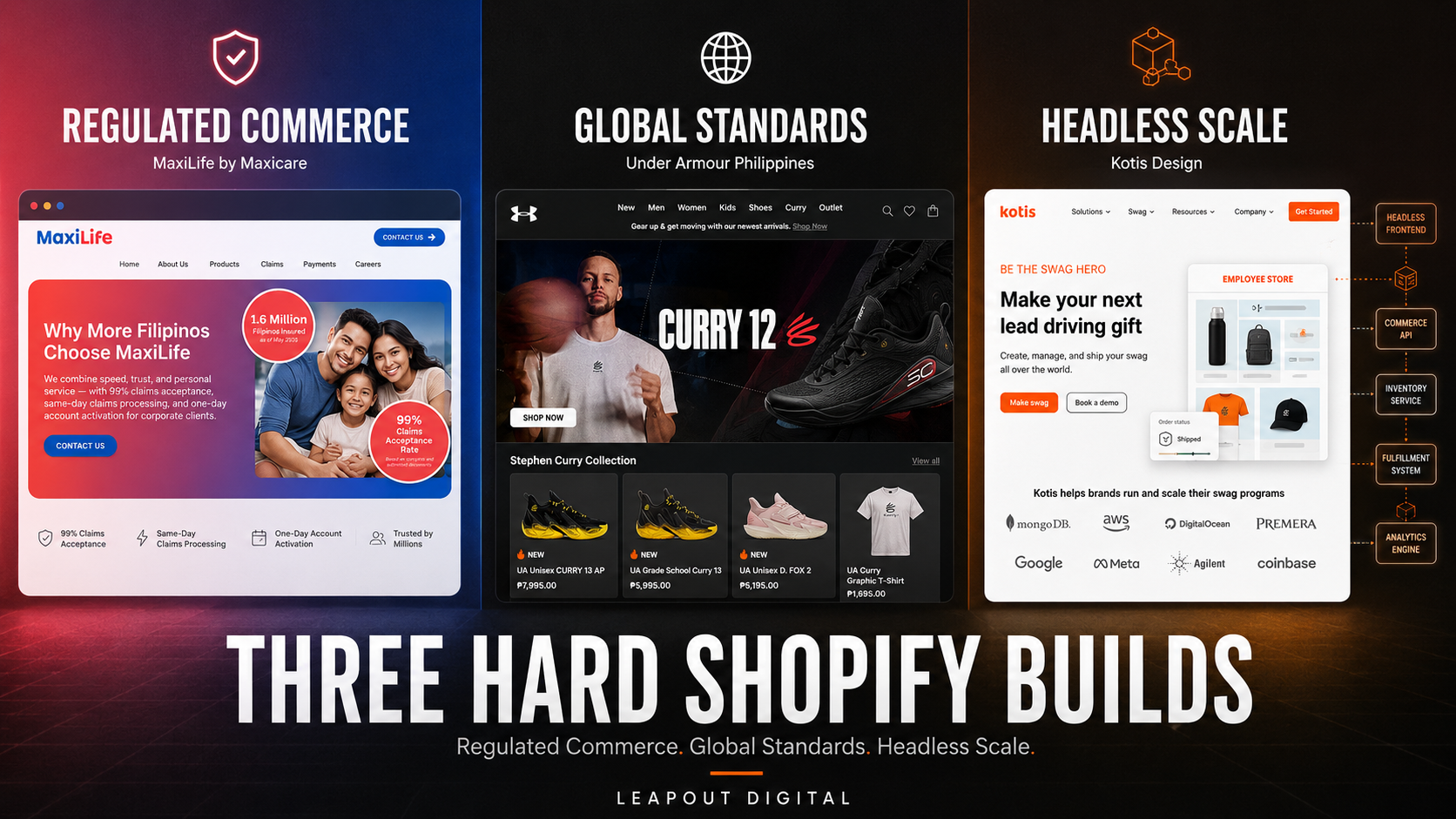
The work required deep front-end customization aligned with global brand standards, strong performance discipline, and careful stakeholder alignment across teams. Shopify Plus gave us the flexibility—but scale demanded governance.

This project reinforced a truth we see often: flexibility without structure creates risk.


Reebok (Shopify Plus): Designing for Longevity

Reebok was our first major Shopify Plus build—and one of the most formative.

At the time, it pushed us to think beyond launch cycles. We had to design theme architecture, performance optimization, and front-end decisions that could hold up over time.

Four years later, the store is still running. That longevity remains one of our proudest indicators of success.


MaxiLife by Maxicare (Shopify Plus): Precision Under Constraint

Healthcare-adjacent commerce brings a unique kind of complexity.

For MaxiLife, we implemented deep technical customization to meet regulatory requirements while ensuring the experience remained intuitive and human. Shopify Plus allowed us to extend the platform safely—but precision was non-negotiable.

The takeaway was clear: constraints don’t eliminate good experience—they demand better design.


Kultura: Scale Through Discoverability

Kultura carries one of the deepest inventories we’ve worked with.

The challenge wasn’t volume—it was discoverability. Our work focused on navigation architecture, SEO structure, and product taxonomy to help customers find meaning within abundance.

Scale without clarity, we learned, quickly becomes friction.


Crate & Barrel Philippines: When Invisibility Is Success

Crate & Barrel required a different posture altogether. 

Our role centered on Shopify SEO and supporting a platform migration with minimal disruption. The goal wasn’t visible change—it was continuity. 

In enterprise environments, the absence of failure is often the highest measure of success.


Chicco Philippines: Operational Complexity Behind a Gentle Brand

Chicco’s challenge lay beneath the surface. Oversized products like strollers required complex shipping logic and fulfillment considerations that standard setups don’t address.

This project reminded us that good commerce design must account for operational reality, not just aesthetics.


Belomed: Speed With Intent

Belomed came with a firm deadline: launch in six weeks, in time for the 2025 holiday season. 

The work required disciplined prioritization and focused execution. Performance post-launch validated the approach, and the platform now serves as a foundation for more ambitious technical plans. 

Speed, we learned, only works when paired with intent.


Saucony Philippines: Translating Heritage Forward 

Saucony’s relaunch was about balance.

We had to honor the brand’s origins while making it relevant to a modern audience. The project involved close collaboration and gradual capability building with the local team.

Growth has followed steadily—proof that heritage only works when it’s translated forward.


OUR HOME: Progress That Compounds

OUR HOME reflects the quieter side of growth.

From early SEO work in 2021 to later UX, navigation, and content improvements, the store has evolved through consistent, incremental enhancements rather than dramatic redesigns. 

It’s a reminder that long-term improvement compounds quietly—but powerfully.


Kotis Design (USA): Extending Shopify Beyond Its Defaults

Kotis Design, a US-based B2B brand serving Fortune 500 clients, exceeded Shopify’s native customization limits.

We built a custom Shopify app to support complex product personalization—marking a milestone in our understanding of Shopify as an extensible platform. 

Platform limits, we found, are often design limits—not technical ones.


Body Wrappers USA: Community as a Constraint

Body Wrappers is a legacy brand deeply rooted in the global dance community. 

Post-relaunch, performance and conversion improved—but more importantly, the work reinforced how community changes design decisions. When you serve a community, responsibility increases.

Sports Central: Growth Shared Over Time


Sports Central was our first professional Shopify build, completed during the pandemic. 

Watching the brand grow since then has been one of the most rewarding parts of our journey. It reminds us that meaningful outcomes are rarely visible at launch—they emerge over time.


Shopify Plus as a Pattern

Across these projects, Shopify Plus emerged not as a feature set, but as a pattern.


It appears when:

scale introduces real risk

governance becomes essential

decisions must endure beyond teams and agencies

Shopify Plus doesn’t simplify complexity—it reveals it.


Designing for What Comes Next 

Today, our Shopify work increasingly accounts for a Gen-AI–driven future. 

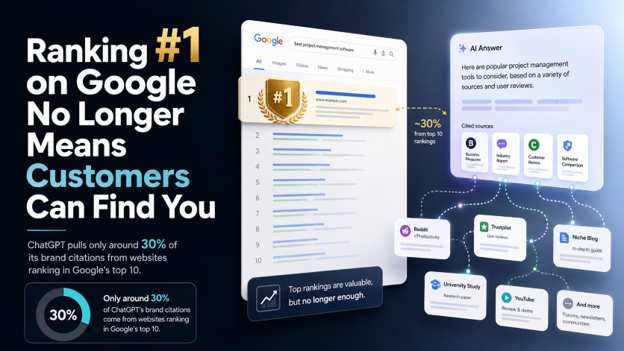
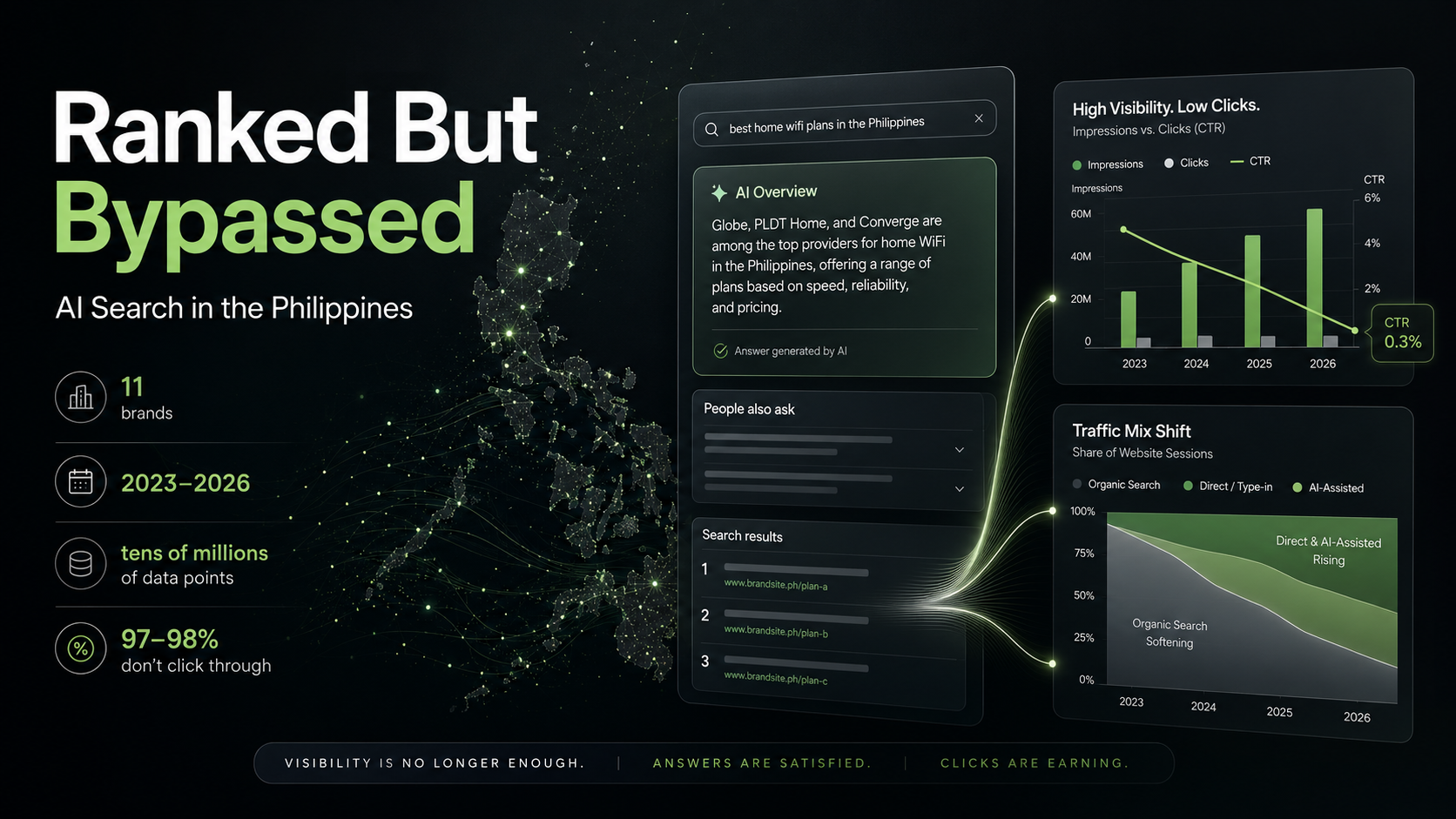
We’re designing platforms that are interpretable by intelligent systems—through clean data structures, clear taxonomy, and durable content architecture. SEO is no longer just about ranking, but about being understood.

We’re also expanding Shopify into food, services, and hybrid business models—focusing not on “pretty websites,” but on future-proof platforms that drive financial growth and customer trust.


A Final Reflection 

Looking across these builds, the common thread isn’t Shopify itself—it’s stewardship. 

Each brand entrusted us with something different: heritage, scale, compliance, speed, or growth. The platform only succeeded when it respected those conditions rather than overriding them.

For teams evaluating Shopify today, the question is no longer whether the platform can scale.

It’s whether the system around it is designed to endure.

Ready to build a Shopify platform that endures? Let’s talk about your project.

 

Picture of Marvin Ortiz
Marvin Ortiz

Marv Ortiz is a leading growth strategist, recognized for driving transformative results for businesses across a variety of industries. As co-founder of LeapOut, Marv has worked with global enterprises and government organizations, helping them achieve measurable outcomes in revenue growth, digital transformation, and market expansion.

With over 16 years of experience, Marv has partnered with a wide range of companies, from fast-growing startups to Fortune Global 500 brands, guiding them through the complexities of digital initiatives and operational enhancements. His strategic insight has helped businesses expand their market presence and optimize performance, positioning them for long-term success.

Known for his ability to deliver tangible, lasting results, Marv is a trusted advisor to business owners and executive teams. His true passion lies in helping both enterprises and SMEs grow, innovate, and achieve sustainable success in competitive environments.

RECENT BLOGS

AEO and GEO for Local Business: The New Rules of Being Found When AI Answers First

AEO and GEO for Local Business: The New Rules of Being Found When AI Answers First I was looking at our agency’s Google Business Profile the other day. Six months of data. 11,000 views. 2,100 searches. 811 interactions. On the surface, healthy numbers. The kind of dashboard that would have made me nod approvingly two years ago.  Then a question landed that I couldn’t shake: how many potential customers searched for an agency like ours in that same window and never showed up in my dashboard at all — because an AI tool answered for them?  That number is unknowable. And that’s exactly the point.  A year ago, a customer searching “best steak near me” got a familiar result: a map with pins, a list of nearby businesses, a stack of reviews. The job of a local business was simple on paper — climb the list, get the click, win the customer.  Today, more of those same customers are asking that question inside ChatGPT, Gemini, Perplexity, or Google’s own AI Overview. They don’t get a list back. They get a paragraph. Three businesses named. Maybe five. A line or two on each. And a decision made before a single map pin has loaded.  If your business isn’t in that paragraph, you don’t exist for that search. And the search never appears in your analytics.  That’s the whole shift. Everything else flows from it.  What Are AEO and GEO, Exactly? Two acronyms are doing the rounds in marketing circles: AEO (Answer Engine Optimization) and GEO (Generative Engine Optimization). Agencies love debating the difference. For most business owners, it’s a distinction without much of a difference.  Answer Engine Optimization (AEO) is the practice of structuring content so that AI assistants like ChatGPT, Perplexity, and voice search cite your business directly inside their answers. Generative Engine Optimization (GEO) is the broader discipline of shaping how generative AI systems — including Google’s AI Overviews and Gemini — perceive, trust, and surface your brand when customers ask questions in natural language.  Different surfaces. Same game. You’re optimizing to be the named answer, not the clicked link.  The reason it matters now is that the underlying numbers have moved fast. A Pew Research Center study of 68,000 real search queries found that when an AI Overview appeared, users clicked on results only 8% of the time, compared with 15% without one — a relative drop of around 47%. Seer Interactive’s analysis of more than 25 million organic impressions found that organic click-through rates on AI-Overview queries fell from 1.76% to 0.61% between mid-2024 and late 2025, a 61% decline. Gartner is now projecting that 25% of organic search traffic will shift to AI chatbots and voice assistants by the end of 2026. Put differently: zero-click searches now account for roughly 58 to 69% of all queries, with the rise directly correlated to AI Overview rollout.  The link economy that powered local SEO for fifteen years is being replaced by an answer economy. The currency has changed.  Is Google Maps Dying? No — But Its Role Is Changing I get asked often whether Google Maps is on the way out. The answer is no. For near-me, “open now,” and “directions to” intent, Maps is probably more durable than most parts of the search experience. Billions of people use it every month.  What’s changing is the role Google Maps — and your Google Business Profile inside it — plays in the broader search ecosystem.  For the last decade, your GBP was a destination. A customer found it, read it, and called. You optimized it so that final page view converted.  In 2026, your GBP is increasingly a data feed. It’s one of the most heavily weighted inputs AI systems use when composing local answers. Your categories, service descriptions, hours, attributes, photos, reviews, and Q&A are no longer just things humans read — they’re machine-readable signals teaching AI what to say about you when someone somewhere asks.  Three implications most local business owners miss:  Staleness is penalized harder than ever. Industry reporting now suggests that GBP profiles that haven’t been updated with fresh photos or posts in over 30 days can see dramatic drops in impressions. AI systems prefer fresh, frequently verified sources. Your profile isn’t a brochure you set up once. It’s a living feed.  A perfect 5.0 isn’t a trophy anymore. AI systems summarize reviews rather than count stars. They look for recency, volume, diversity of voice, and how owners engage with criticism. A profile with a perfect 5.0 rating and zero negative feedback can actually be flagged as suspicious by AI filters. A 4.6 with 200 recent reviews and thoughtful owner replies often outperforms it. The trust signal is authenticity, not spotlessness.  What isn’t structured doesn’t get counted. AI systems can only cite what they can confidently understand. LocalBusiness schema, service pages with clear question-and-answer structure, and consistent name-address-phone details across directories used to be nice-to-haves. They’re now the difference between being legible to AI systems and being invisible to them.  Look at our own profile again. 80% strength. Google itself is telling us there’s 20% of signal we haven’t given it yet. Multiply that across every local business I know — most are sitting somewhere between 60 and 80% — and you start to see the collective blind spot. We’ve been leaving machine-readable signal on the table for years, because the cost of leaving it there was minimal. In the answer economy, that cost compounds.  Separately, a bigger wave is approaching. Agentic AI — where AI assistants don’t just recommend a business but book the appointment, check availability, and complete the transaction on the user’s behalf — is moving from roadmap to reality. That future compresses the customer journey even further. Whoever the AI picks doesn’t just win the recommendation. They win the booking.  How Can Local Businesses Optimize for AEO and GEO? You don’t need to become technical overnight. But you do need to change what you’re playing for.  Stop chasing rank. Start earning citations.  Five moves matter more than the rest.  Treat your GBP like a product, not a profile. Publish

Continue Reading

Shopify B2B Is Now Available on Every Plan: What It Means for Merchants (and the Playbook to Launch It)

On April 2, 2026, Shopify extended its native B2B features to merchants on Basic, Grow, and Advanced plans — ending nearly four years of Plus-only access. Here’s why the announcement matters, what it unlocks for Southeast Asian merchants, and a step-by-step playbook for getting your first wholesale buyer live. The news, in one line Shopify B2B — company profiles, custom catalogs, volume discounts, quantity rules, vaulted credit cards, and payment terms — is now available at no extra cost on Basic, Grow, and Advanced plans. Previously, these features were exclusive to Shopify Plus.  For nearly four years, native B2B lived behind the Plus paywall. That paywall was the single biggest structural reason DTC-first brands didn’t touch wholesale. It wasn’t that the demand wasn’t there — it was that doing it properly meant either replatforming or stitching together third-party apps. Both were expensive. Both killed momentum.  That reason is now gone. What replaces it is a harder problem most merchants aren’t ready to face: designing a B2B offer worth buying.  Why Shopify opening B2B to every plan matters The global B2B ecommerce market is worth roughly $36 trillion — an order of magnitude larger than DTC. Most brand founders don’t feel the gap because their entire operating stack (ads, funnels, attribution, CRM) is built for the consumer. Procurement lives in a different universe.  But the signals are almost always there. A retailer DMs asking for wholesale pricing. A clinic chain places five identical orders in a month. A corporate gifting buyer asks for an invoice with payment terms. Most merchants treat these as edge cases. They’re not edge cases. They’re the opening of a second business inside the first one.  Shopify’s own data on merchants already running B2B is hard to ignore:  Up to 4.1x reorder frequency versus DTC  Up to 33% increase in self-serve orders within six months  40% higher average customer spend (Snyder Performance Engineering case)  25% reduction in back-office time  Those numbers don’t come from a new acquisition channel. They come from unlocking revenue that was already trying to happen.  What’s now included on Basic, Grow, and Advanced plans Shopify merchants on non-Plus plans now have access to:  Company profiles for wholesale buyers (separate identity from DTC customers)  Up to three custom catalogs with tailored pricing per buyer group  Volume discounts and quantity rules (tiered pricing, minimum order quantities)  Vaulted credit cards for repeat-order convenience  Payment terms — Net 15, Net 30, Net 60, and custom arrangements  Native integration with Shopify Payments, Shopify Flow, and Shopify Markets  Everything runs from one admin. One source of truth for both DTC and B2B. No plugins required.  What’s still exclusive to Shopify Plus For brands with complex wholesale operations, Plus retains meaningful advantages:  Unlimited custom catalogs (vs. the three-catalog cap on lower tiers)  Direct catalog assignment to specific companies and company locations  Partial payments and deposits  Advanced B2B checkout customization  The full suite of enterprise B2B workflows  The takeaway: Plus remains the right home for brands with dozens of wholesale accounts across multi-location buyers. For everyone else — the 90% whose B2B ambition starts with “a handful of clinics,” “twenty boutique resellers,” or “a growing list of cafes” — three catalogs is more than enough to test, prove, and scale before replatforming becomes a real question.  What this unlocks for Southeast Asian merchants Most SEA-based Shopify brands are on Basic, Grow, or Advanced. Plus adoption in the region remains concentrated among enterprise merchants. Which means native B2B, until this rollout, was effectively out of reach for the majority of brands who would benefit from it most — DTC-first operators with growing trade demand they didn’t know how to serve.  Here’s what that looks like on the ground.  The skincare brand getting DMs from clinics. A Manila-based skincare label notices aesthetic clinics and spas ordering in bulk through regular checkout, then asking for invoices and wholesale pricing after the fact. Instead of building a messy workaround, they spin up a B2B catalog with per-unit pricing tiers and Net 30 terms. Each clinic gets a company profile. Orders now self-serve, invoices go out automatically, and the founder stops being the accounts receivable department.  The coffee roaster selling to cafes. A specialty roaster outside Metro Manila has fifteen cafes on a Viber order list, each messaging their weekly orders to one sales coordinator. They move that list onto a B2B catalog with per-kilo pricing, a 5kg minimum, and vaulted card payment. Cafes log in, reorder their usual, and get dispatched the same day. The sales coordinator stops managing spreadsheets and starts calling prospects.  The apparel brand selling to boutiques. A streetwear label building a reseller network creates a tiered catalog — Tier 1 at 40% off RRP with a 50-unit quarterly commitment, Tier 2 at 30%. Each boutique logs in, sees only their pricing, and places orders without renegotiating every season. Sell-through data starts flowing in, and the brand finally learns which retailers are actually moving product versus sitting on inventory.  The wellness brand doing corporate gifting. A supplements brand gets a Q4 inquiry from a corporate wellness program for 500 curated bundles. Instead of handling it over email with a spreadsheet, they create a company profile for the client, a private catalog with the negotiated bundle price, and invoice-based payment terms. Next year, the same client reorders themselves. A new revenue line exists inside the same store.  None of these require replatforming. None require an agency to build a custom portal. All of them require the brand to decide what its B2B offer actually is. The trap: the tech is easy. The commercial design isn’t. This is the part most merchants will miss.  Turning on native B2B takes an afternoon. Designing a B2B offer that’s actually worth buying takes real thinking. What’s your MOQ? What’s your wholesale margin structure? Who qualifies for Net 30 and who pays upfront? What does pricing look like for a boutique committing to a quarterly order versus one reordering ad hoc? Do you ship to multi-location companies, and how do you handle split invoicing and taxes?  These are commercial questions, not technical ones. Shopify just removed the technical excuse. The brands

Continue Reading

GEO in the Philippines:
Why Most Filipino Businesses—Especially E-Commerce—Are Already Behind

Marv  │  Managing Partner, LeapOut Digital  │  Former Head of Search, Major US Retail E-commerce  │  April 2026 I lead a team of search specialists—SEO and SEM—for one of the largest US retail e-commerce operations before moving back to build LeapOut Digital. I’ve managed search strategy across millions of SKUs, watched consumer intent data at scale, and seen firsthand how a single infrastructure decision can either surface or bury an entire product catalog. When I say most Philippine businesses are not ready for Generative Engine Optimization—I’m not guessing. I’m pattern-matching against what I watched happen in US retail five years ago. We had the same debates. The same hesitations. The same tendency to wait until the problem was undeniable. GEO is the practice of optimizing your content and brand presence so that AI platforms—ChatGPT, Google AI Overviews, Perplexity, Gemini, Claude—cite, mention, or recommend you when users ask questions. Not ranking at position #1. Being part of the answer itself. This article covers GEO for all businesses. But I’m going to spend significant time on e-commerce specifically—because the e-commerce challenge is more structural, more urgent, and more misunderstood than most GEO content acknowledges. 🇵🇭  The Philippine context in one sentence: Filipinos are high-volume, high-trust searchers—and AI search is now inheriting that trust. When ChatGPT or Gemini gives a confident answer in the Philippines, users act on it. Being cited is no longer just a visibility play. It’s a trust play.   1. AI Is Already Deciding What Gets Bought Before we talk strategy, look at what’s already happening. These two screenshots are from real AI conversations in the Philippines on April 2, 2026. SCENARIO 1: “I WANT A DESSERT THAT CAN DELIVER TODAY IN SAN JUAN CITY” AI recommends a specific store, explains why it fits, and suggests an exact order. Beard Papa’s Greenhills won—not because they ran ads, but because their data was accessible. SCENARIO 2: “I AM A BJJ DAD LOOKING FOR INNER SPORTSWEAR THAT CAN DELIVER IN 5 DAYS” AI reads the buyer’s context, filters by delivery reliability, and surfaces specific SKUs with prices and ratings. Decathlon, ZALORA, adidas.com.ph, Nike Philippines won the citation. No ad was served. What these screenshots are telling you: AI is not just answering questions. It is making purchasing recommendations with specific products, specific prices, specific stores, and specific delivery windows. If your brand, product, or store didn’t appear in those answers—it’s not because the AI couldn’t find you. It’s because your data wasn’t structured well enough for the AI to trust you with a recommendation. 2. GEO vs. SEO: The Key Differences Understanding GEO starts with knowing how it differs from—and builds on—traditional SEO services in the Philippines. The table below captures the key distinctions.   3. The E-Commerce Problem Nobody’s Talking About Here’s the conversation I keep having with e-commerce clients: “We have 10,000 SKUs. Our site is on Shopify. We’re running Google Shopping. We’re doing SEO. Why aren’t we showing up in AI answers?” The answer is structural—and it has nothing to do with how much content you have. The Deep Catalog Problem A traditional search engine indexes your pages and ranks them. A generative AI does something fundamentally different: it reads your product data, evaluates whether it can confidently recommend a specific product for a specific user need, and makes a judgment call. For a business with 10,000 SKUs, that judgment call fails for most of your catalog because: Product descriptions are written for humans, not machines. “Premium quality, stylish design, perfect for any occasion.” This tells an AI nothing. It cannot answer “is this good for sweat management?” from that description. Attributes are incomplete or inconsistent. Size, color, material, use case, compatibility—these need to be machine-readable structured fields, not prose buried in a paragraph. Inventory data is stale or siloed. AI agents need real-time stock levels per location. If your inventory system doesn’t sync with your product pages, the AI cannot confidently recommend a product with a specific delivery window. Schema markup is missing or shallow. Most PH e-commerce stores implement basic product schema at best. The full picture—availability by variant, shipping estimates, return policy, aggregate ratings—is rarely structured correctly.   What AI needs vs. what most PH e-commerce stores provide Source: LeapOut assessment framework, industry benchmarks (Mirakl, Creatuity 2026). PH estimates based on client audits.   The Merchandising Disconnect Here’s what makes this worse for Philippine e-commerce specifically: most local brands separate their merchandising team from their SEO team. The people who decide how products are described are not the same people optimizing for search. With traditional SEO, that gap was manageable. With GEO, it’s a structural failure. AI systems make recommendations by synthesizing product attributes, reviews, delivery capabilities, and brand credibility. If your merchandising data doesn’t feed correctly into a machine-readable format, the AI simply skips you—not out of preference, but out of insufficient confidence. The merchandising fix: GEO forces a conversation that should have happened at the start of every e-commerce build: “How will a machine understand this product?” Every SKU needs structured, attribute-level data that answers the questions a customer would ask an expert: What is it made of? What is it best used for? What size/color/variant is in stock? How fast can it deliver to this location? What do verified buyers say about it? If your product page can’t answer those questions in a machine-readable format, you are invisible to AI agents regardless of your SEO rankings. 4. Can AI Actually Recommend a Specific Product From 10,000 SKUs Based on Color, Stock, and Delivery? This is the question I get most from e-commerce operators—and it’s the right question to ask. The honest answer: yes, but only if your infrastructure supports it. And most stores’ infrastructure does not. Let me break down what has to be true for an AI agent to answer: “I want a navy blue compression top in large, in stock, that can deliver to Quezon City within 5 days.”   What Actually Happens When You Ask AI to Shop for

Continue Reading