AEO and GEO for Local Business: The New Rules of Being Found When AI Answers First
I was looking at our agency’s Google Business Profile the other day. Six months of data. 11,000 views. 2,100 searches. 811 interactions. On the surface, healthy numbers. The kind of dashboard that would have made me nod approvingly two years ago.
Then a question landed that I couldn’t shake: how many potential customers searched for an agency like ours in that same window and never showed up in my dashboard at all — because an AI tool answered for them?
That number is unknowable. And that’s exactly the point.
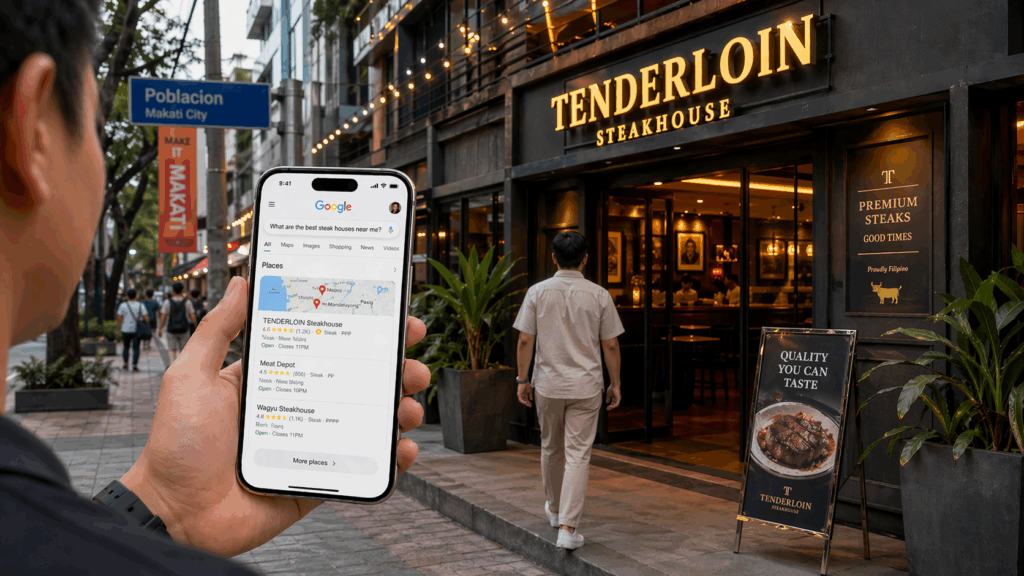
A year ago, a customer searching “best steak near me” got a familiar result: a map with pins, a list of nearby businesses, a stack of reviews. The job of a local business was simple on paper — climb the list, get the click, win the customer.
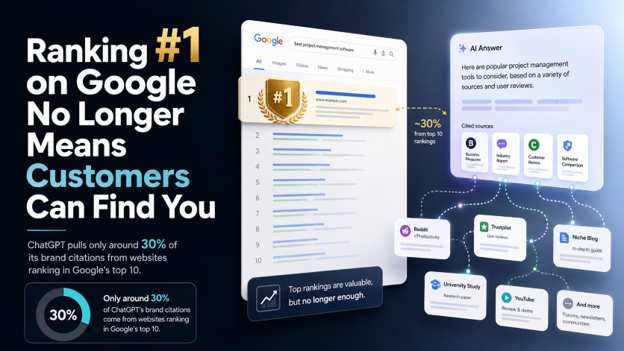
Today, more of those same customers are asking that question inside ChatGPT, Gemini, Perplexity, or Google’s own AI Overview. They don’t get a list back. They get a paragraph. Three businesses named. Maybe five. A line or two on each. And a decision made before a single map pin has loaded.
If your business isn’t in that paragraph, you don’t exist for that search. And the search never appears in your analytics.
That’s the whole shift. Everything else flows from it.
What Are AEO and GEO, Exactly?
Two acronyms are doing the rounds in marketing circles: AEO (Answer Engine Optimization) and GEO (Generative Engine Optimization). Agencies love debating the difference. For most business owners, it’s a distinction without much of a difference.
Answer Engine Optimization (AEO) is the practice of structuring content so that AI assistants like ChatGPT, Perplexity, and voice search cite your business directly inside their answers. Generative Engine Optimization (GEO) is the broader discipline of shaping how generative AI systems — including Google’s AI Overviews and Gemini — perceive, trust, and surface your brand when customers ask questions in natural language.
Different surfaces. Same game. You’re optimizing to be the named answer, not the clicked link.
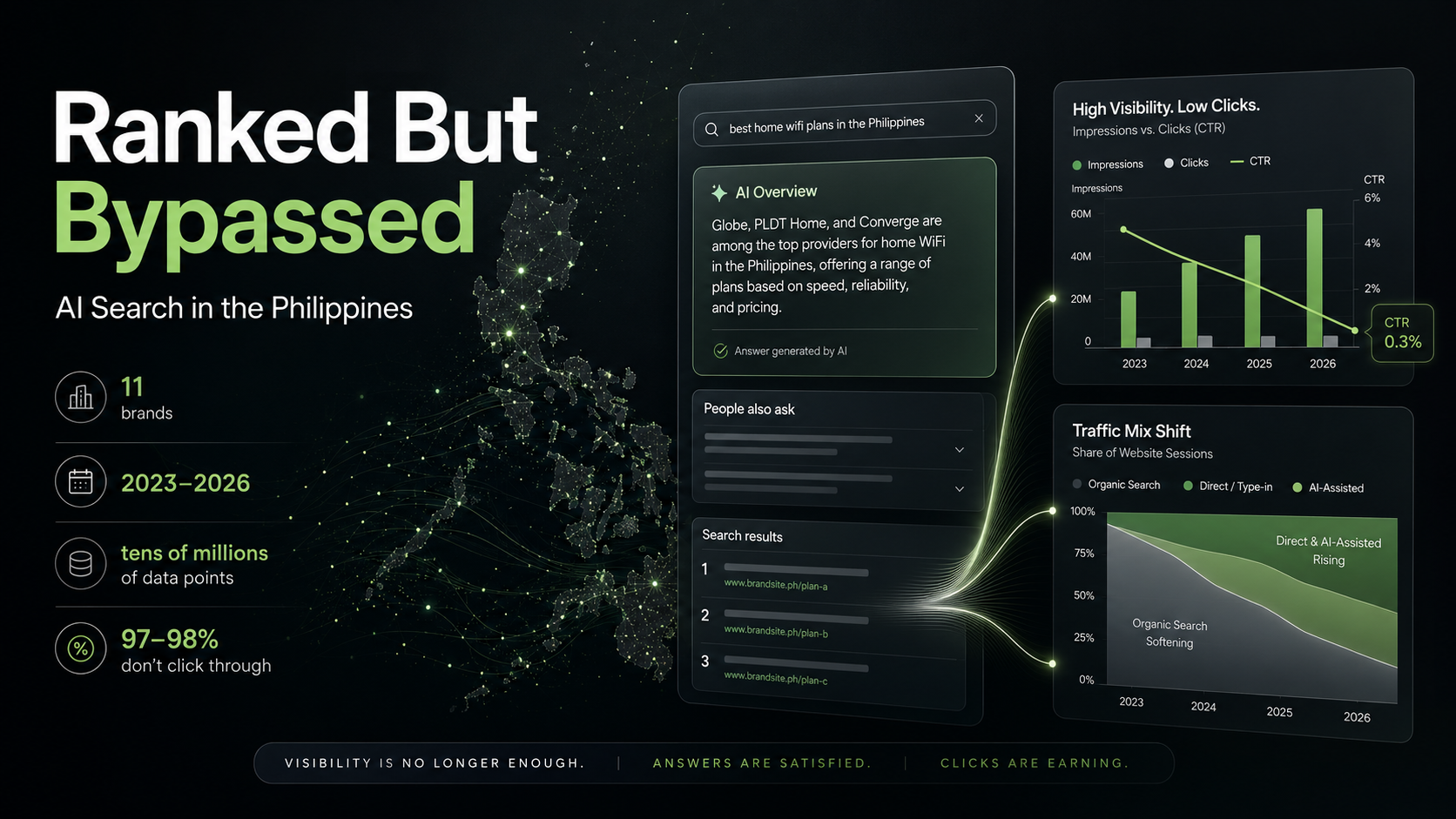
The reason it matters now is that the underlying numbers have moved fast. A Pew Research Center study of 68,000 real search queries found that when an AI Overview appeared, users clicked on results only 8% of the time, compared with 15% without one — a relative drop of around 47%. Seer Interactive’s analysis of more than 25 million organic impressions found that organic click-through rates on AI-Overview queries fell from 1.76% to 0.61% between mid-2024 and late 2025, a 61% decline. Gartner is now projecting that 25% of organic search traffic will shift to AI chatbots and voice assistants by the end of 2026. Put differently: zero-click searches now account for roughly 58 to 69% of all queries, with the rise directly correlated to AI Overview rollout.
The link economy that powered local SEO for fifteen years is being replaced by an answer economy. The currency has changed.
Is Google Maps Dying? No — But Its Role Is Changing
I get asked often whether Google Maps is on the way out. The answer is no. For near-me, “open now,” and “directions to” intent, Maps is probably more durable than most parts of the search experience. Billions of people use it every month.
What’s changing is the role Google Maps — and your Google Business Profile inside it — plays in the broader search ecosystem.
For the last decade, your GBP was a destination. A customer found it, read it, and called. You optimized it so that final page view converted.
In 2026, your GBP is increasingly a data feed. It’s one of the most heavily weighted inputs AI systems use when composing local answers. Your categories, service descriptions, hours, attributes, photos, reviews, and Q&A are no longer just things humans read — they’re machine-readable signals teaching AI what to say about you when someone somewhere asks.
Three implications most local business owners miss:
Staleness is penalized harder than ever. Industry reporting now suggests that GBP profiles that haven’t been updated with fresh photos or posts in over 30 days can see dramatic drops in impressions. AI systems prefer fresh, frequently verified sources. Your profile isn’t a brochure you set up once. It’s a living feed.
A perfect 5.0 isn’t a trophy anymore. AI systems summarize reviews rather than count stars. They look for recency, volume, diversity of voice, and how owners engage with criticism. A profile with a perfect 5.0 rating and zero negative feedback can actually be flagged as suspicious by AI filters. A 4.6 with 200 recent reviews and thoughtful owner replies often outperforms it. The trust signal is authenticity, not spotlessness.
What isn’t structured doesn’t get counted. AI systems can only cite what they can confidently understand. LocalBusiness schema, service pages with clear question-and-answer structure, and consistent name-address-phone details across directories used to be nice-to-haves. They’re now the difference between being legible to AI systems and being invisible to them.
Look at our own profile again. 80% strength. Google itself is telling us there’s 20% of signal we haven’t given it yet. Multiply that across every local business I know — most are sitting somewhere between 60 and 80% — and you start to see the collective blind spot. We’ve been leaving machine-readable signal on the table for years, because the cost of leaving it there was minimal. In the answer economy, that cost compounds.
Separately, a bigger wave is approaching. Agentic AI — where AI assistants don’t just recommend a business but book the appointment, check availability, and complete the transaction on the user’s behalf — is moving from roadmap to reality. That future compresses the customer journey even further. Whoever the AI picks doesn’t just win the recommendation. They win the booking.
How Can Local Businesses Optimize for AEO and GEO?
You don’t need to become technical overnight. But you do need to change what you’re playing for.
Stop chasing rank. Start earning citations.
Five moves matter more than the rest.
Treat your GBP like a product, not a profile. Publish weekly. Upload real photos, not stock imagery. Update hours for holidays. Respond to every review within 24 hours — not because customers demand it, but because AI systems are watching the cadence. If you can’t commit to that yourself, delegate it cleanly. Think of it the way you’d think of a shop window you walk past every morning. If it looks the same for six months, people stop looking at it. Algorithms do too.
Write for the librarian, not the keyword. The old SEO playbook was “rank a page for ’plumber in Austin.’” The new playbook is “become the source an AI wants to cite when recommending plumbers in Austin.” Those are different jobs. One rewards keyword stuffing. The other rewards clear, structured, genuinely useful content that answers the questions your customers actually ask — in their words, not yours. Service pages, pricing guides, FAQs, comparisons, how-we-do-it explainers. Your goal is to be the most extractable, trustworthy source on your topic.
Build entity authority, not link count. AI systems evaluate you based on how consistently you show up across the web — mentions in industry publications, citations in third-party directories, podcast appearances, reviews on multiple platforms, PR. Your brand exists in the memory of AI models roughly in proportion to how often you credibly appear elsewhere. Backlinks still help. But mentions — even without a link — now carry weight they didn’t before. Which means PR, partnerships, and being quoted are no longer luxury marketing. They’re AI visibility infrastructure.
Own the first 100 words of every service page. Lead with the answer, not the introduction. Most AI citations are pulled from content that answers the question directly in the opening paragraph. If your service page opens with “Welcome to our family-owned business, founded in 1998…” you’re training every AI system to skip past you. Put the answer on top. Put the story underneath. Think of it like a front-page newspaper article, not a wedding speech.
Track share of voice, not just rankings. If you’re still only measuring keyword positions, you’re measuring the wrong thing. Every month, ask ChatGPT, Gemini, and Perplexity the five or six questions your best customers would ask before hiring you. See if you’re named. See who’s getting named instead. That gap is the work.
The Window Is Unusually Open — For Now
Here’s the part most agencies won’t tell you. The competition for AI visibility is absurdly low right now. Industry data suggests roughly 73% of businesses are completely invisible in ChatGPT today, even in highly competitive categories. In markets outside the US and UK — across Southeast Asia, Latin America, the Middle East — the first-mover gap is even wider. In the Philippines, for instance, around 42% of internet users now use ChatGPT monthly, placing the country sixth globally in adoption, yet the number of local businesses actively optimizing for AI visibility is close to zero.
That gap won’t last. It never does. The businesses that show up early in AI-generated answers are the ones whose reputations get reinforced every time a user asks a question — a compounding loop, not a linear one. The businesses that wait will spend the next three years trying to dislodge incumbents they helped create by doing nothing.
Search didn’t die. It changed shape. The retailers who won the 2010s were the ones who figured out Google before their competitors did. The local businesses that win the late 2020s will be the ones who figure out how to be named — by the systems that now decide what counts as an answer.
Your 4.8 stars won’t save you. Your rank-one listing won’t either. Even a healthy-looking dashboard won’t, because dashboards only measure the customers who reached you. Not the ones who asked an AI and heard someone else’s name.
Being the answer will.
Frequently Asked Questions
What is the difference between SEO and AEO?
Traditional SEO optimizes a page to rank in a list of blue links. AEO optimizes content to be cited directly inside an AI-generated answer, where the user may never see a list at all. SEO wins clicks. AEO wins mentions. Both still matter — but the balance of value is shifting toward mentions.
Does AEO replace Google Business Profile optimization?
No. GBP optimization is now a foundational input for AEO and GEO. Your profile’s data — categories, photos, hours, reviews, service descriptions — is one of the most heavily weighted sources AI systems use when answering local queries. The right framing is that GBP has evolved from a destination page into a machine-readable data feed.
How do I know if my business is visible in AI search?
Ask ChatGPT, Gemini, and Perplexity the five or six questions your best customers would ask before buying from you — questions like “best [your category] in [your city]” or “who should I hire for [your service] near me.” See whether your business is named. See who is being named instead. That gap is the most important visibility metric most local businesses aren’t yet tracking.
How long does it take to show up in AI answers?
Faster than traditional SEO, but not instant. Businesses that commit to consistent signal — regular GBP updates, structured content, third-party mentions, genuine reviews — typically begin appearing in AI citations within 60 to 120 days. Authority in AI systems compounds; the early movers in any category tend to stay named.

Marvin Ortiz is the Co-Founder and Managing Partner of LeapOut, a Shopify Plus Partner agency based in Manila. Over the past 8+ years, LeapOut has helped enterprise brands — including Under Armour, Bench, Reebok, and Saucony — grow visibility, traffic, and revenue online. He writes weekly on AI, ecommerce, and digital strategy in the Clicks & Bytes newsletter.