Shopify Optimization: Tips to Gear Up Your Store in 2024

Shopify Optimization: Tips to Gear Up Your Store in 2024

Does your e-commerce site fail to reach your expected results, even though your online store is run by Shopify?   

One of the probable reasons is it is not fully optimized for 2024. 

Like in any Shopify website, seeing that your ecommerce site runs smoothly is not enough to ensure its profitability. You still need to apply technical tweaks and fine tuning to improve its marketability, especially in the eyes of your customers and search engines like Google. 

The success of your e-commerce store optimization depends on how fast you adapt to the trends and technological developments. Even the most established platforms need constant care to stay ahead. In 2024, optimizing your Shopify store is no longer an option but a necessity for survival and growth.

That’s where LeapOut comes in. If you’re one of 8,328 Shopify store operators or are planning to open up an e-commerce store on this platform, our digital marketing experts provide an actionable roadmap to optimize your Shopify site. 

We’ll equip you with proven strategies and practical tips to maximize your online presence, attract more customers, and unlock the full potential of your store in the exciting year ahead. Read on…

2024 E-commerce Landscape Trends 

The pace of the e-commerce landscape evolution has stepped up in 2024, presenting both challenges and opportunities for businesses of all sizes. To stay relevant in the market, you need to understand these trends and emerging consumer behaviors:

Mobile-Powered Shopping Experience

In 2024, our mobile phones will be the primary touchpoint of our shopping journey. It is an integral part of the shopping journey, with over 83% of e-commerce activities utilizing it. According to Statista, the Philippine mobile e-commerce market registered a total retail sales of US$4.28 billion in 2021, reflecting a massive six-fold increase within five years from the total sales value of US$608.1 million U.S. dollars in 2017. 

Mobile e-commerce is seen to continue growing, with an estimated retail sales value of roughly US$8 billion in 2026.

Experts attribute the impressive growth in m-commerce sales to many factors, including convenience and flexibility of shopping only through consumers’ fingertips. The use of mobile payment options with local mobile wallets like GCash, Maya, PayMongo, and its counterparts like Alipay, Apple Pay and Google Pay also makes m-commerce a more convenient choice. 

These advanced features allow shoppers to complete transactions with just a few clicks, eliminating the need to fumble with cash or credit cards. This frictionless payment process encourages faster, more convenient transactions. 

Experience-driven commerce is on the rise

Consumers are already bored with simply clicking and buying online. They crave immersive and engaging experiences throughout their shopping journey especially after being restricted by the pandemic. Here are some of the rising trends to look out this year:

  • Augmented reality (AR) and virtual reality (VR) applications, allowing virtual try-ons, product visualization in their homes, and interactive experiences.
  • Livestream shopping is booming, opening up the avenue for real-time interaction with brands and influencers.
  • Social commerce competition heats up, especially with platforms like Facebook, TikTok, and Instagram, integrating seamless buying experiences directly within their apps.

Personalization Becomes a Norm

Generic and shotgun marketing methods no longer work in 2024. AI tools empower your website to give personalized recommendations, offers, and content tailored to your customers’ unique needs and preferences. By analyzing vast amounts of data, AI can provide relevant experiences to make your buyers feel special when purchasing in your store.

Treat Your Customers with Quick and Easy Shopping

In today’s fast-paced world, customers look for convenience. They expect quick and easy shopping experiences, including:

  • Frictionless checkout processes that support multiple payment options.
  • Fast and reliable delivery with transparent and reliable tracking information.
  • Seamless omnichannel experiences, allowing them to switch between devices and channels effortlessly.

Voice Search Gains Momentum

Alexa, Siri, Google Home and other voice assistants are expected to take center stage, leading to a rise in voice-activated shopping. As human-computer interaction is rapidly becoming a norm and devices are slowly accommodating both typing and voice interaction. 

Because of this, e-commerce sites are slowly adopting Voice UI (user interfaces), making them accessible in mobile phones, TVs, smart home gadgets, and other devices.

Optimizing your website for voice search has these benefits:

  • Convenience – Voice commands are fast and hands-free, perfect for shoppers on the go or multitasking.
  • Enhanced accessibility – Voice search empowers those with disabilities or who find typing difficult to still shop effortlessly.
  • Improved search experience – Customers can quickly find products, ask questions, and even complete purchases with simple voice commands.

Tips to Optimize Your Shopify Store

As an existing e-commerce site owner or are new to this business model, you need to adapt to these trends to gain a headstart in 2024. Fortunately, Shopify has the right features and tools to optimize your site according to the latest developments in the market.

Embrace Mobile-First 

For many years, many websites, including online stores, still lag behind in terms of mobile optimization. While their sites look impressive on desktops, their mobile versions cause lots of frustration to customers leading to abandoned carts and decrease in sales.


Here are some ways to optimize your website for mobile phones:

Responsive Design

Think of responsive design as the flexible foundation of your mobile store. It’s the magic that makes your content, images, and buttons dance beautifully on any screen size. Choose a responsive Shopify theme or hire a developer to ensure that your site provides top-notch mobile experience.

Page Load Speed

Understand that mobile users are impatient. Imagine this, a one-second delay can reduce conversion rates by 7%. Seek help from developers, SEO specialists, or UX designers to keep your store loading at lightning speed:

  • Optimize your images
  • Minify code
  • Invest in a reliable hosting 

Frictionless Checkouts 

Offer a simple, one-page checkout process tailored for touchscreens with auto-fill options.  This design will reduce frustrations in using your site due to complexity in design. 

Integrate Social Media Accounts

In today’s digital landscape, social media isn’t just a way to connect – it’s a powerful sales driver. Integrating your social media accounts with your Shopify site can expand your website’s reach, drive traffic, and boost your online sales.

Shopify Sales Channels

Shopify makes it easy! Go to Sales Channels under the admin dashboard to add platforms like Facebook, Instagram, and Pinterest.

Create Shoppable Posts

Tag products directly in your social media posts, allowing for a frictionless buying experience.

Social Sharing Buttons

Include prominent sharing buttons on your product pages to encourage customers to spread the word.

Integrate AR/VR in Your Site

Immersive virtual experience from AR and VR are reshaping the e-commerce landscape. Fortunately, you can integrate these immersive technologies into your Shopify site, making integration easier than ever.


Here’s what you need to leverage AR/VR on your site:

Create 3D Models

You can hire a 3D artist or use 3D modeling software to create high-quality 3D models of your products optimized for AR/VR.

Install AR/VR App

Explore Shopify’s App Store for compatible apps like Angle 3D Configurator and Odyssey 3D that fit your needs and budget. Many offer simple setup processes.

Optimize for Voice Search

Building and operating an e-commerce store can streamline the buying journey of your customers, that can boost its performance and profitability. Aside from the usual voice search optimization practices like understanding voice search behavior, keyword research, product page optimization, technical optimization, and local SEO, you can also leverage these features:  

  • Shopify Apps – The Shopify App Store offers several voice search and commerce apps providing varying levels of functionality like Voice Search by MyAppGurus consider search accuracy, multi-language support and others.
  • Smart Speakers – Optimize your product listings and website for voice search engines that power devices like Amazon Alexa and Google Home.
  • Conversational AI – Consider advanced solutions for a highly personalized, human-like voice shopping experience.

Power Your Site with AI

AI is welcome (or frowned upon) by many sorts of professionals, including e-commerce specialists and digital marketers. By utilizing this technology, e-commerce pros can work with ease by automating routine tasks such as:

Product Recommendations

The Shopify App Store has tons of AI-powered recommendation engines like Recomify, LimeSpot, and more. These apps often plug in seamlessly with your store. Meanwhile, those with complex or highly specific needs may hire a developer to build a tailored recommendation system using AI frameworks.

Smart Search

Apps like Searchanise, Findify, and Algolia provide advanced search capabilities powered by AI.

You can also consider a custom solution if you have unique requirements or a large, complex product catalog.

Chatbots and Virtual Assistants

Use apps like Gobot, Ada, or Heyday for easy chatbot setup optimized for e-commerce.

You can also utilize chatbot building platforms like Dialogflow or ManyChat and integrate them with your Shopify store.

Image Recognition

AI can analyze product images, allowing users to search visually like uploading a picture of a dress they like to find similar items in your store. Consider using Visual Search or Syte offer image-based search functionality. 

Inventory and Demand Forecasting

AI provides tremendous help to business owners and specialists like you. It helps them analyze sales data, trends, and external factors to predict future demand, optimizing stock levels, helping prevent dead stock, and minimizing lost sales. Apps dedicated to forecasting like Lokad or DataQlick will do these tasks for you.

If you are operating larger stores with complex data sets, you may need to work with a  development team on data modeling and prediction.

Get More Sales from Your Shopify Store With LeapOut

Setting up and operating a Shopify store is a challenging venture, especially if you’re not a tech-oriented person. To succeed in this field, you need to keep updated with the latest trends to keep up with the competition and attract more customers. You should also know the latest features and capabilities of your online store to optimize your e-commerce site. 

To ensure your store’s continuous success amid changing times, you need Shopify experts like those in LeapOut’s Shopify development team. Contact us now to boost your site’s performance in line with the latest trends and requirements.

Picture of Tony Chua
Tony Chua

Tony Chua is an adept Web Content Specialist and HubSpot-certified professional, with an Economics degree from the University of Santo Tomas and over ten years in content creation. Specializing in SEO articles, blog posts, and social media content, Tony has a diverse background encompassing news writing, press releases, and editorial work.

His multifaceted expertise also covers desktop publishing, graphic design, web development, and video editing. At LeapOut Digital, Tony applies his versatile skills to enhance digital narratives and engage a global audience through compelling content.

RECENT BLOGS

Headless Shopify development in the Philippines showcasing enterprise eCommerce solutions, custom integrations, and scalable storefronts by LeapOut Digital

Enterprise & Headless Shopify Builds in the Philippines | LeapOut 

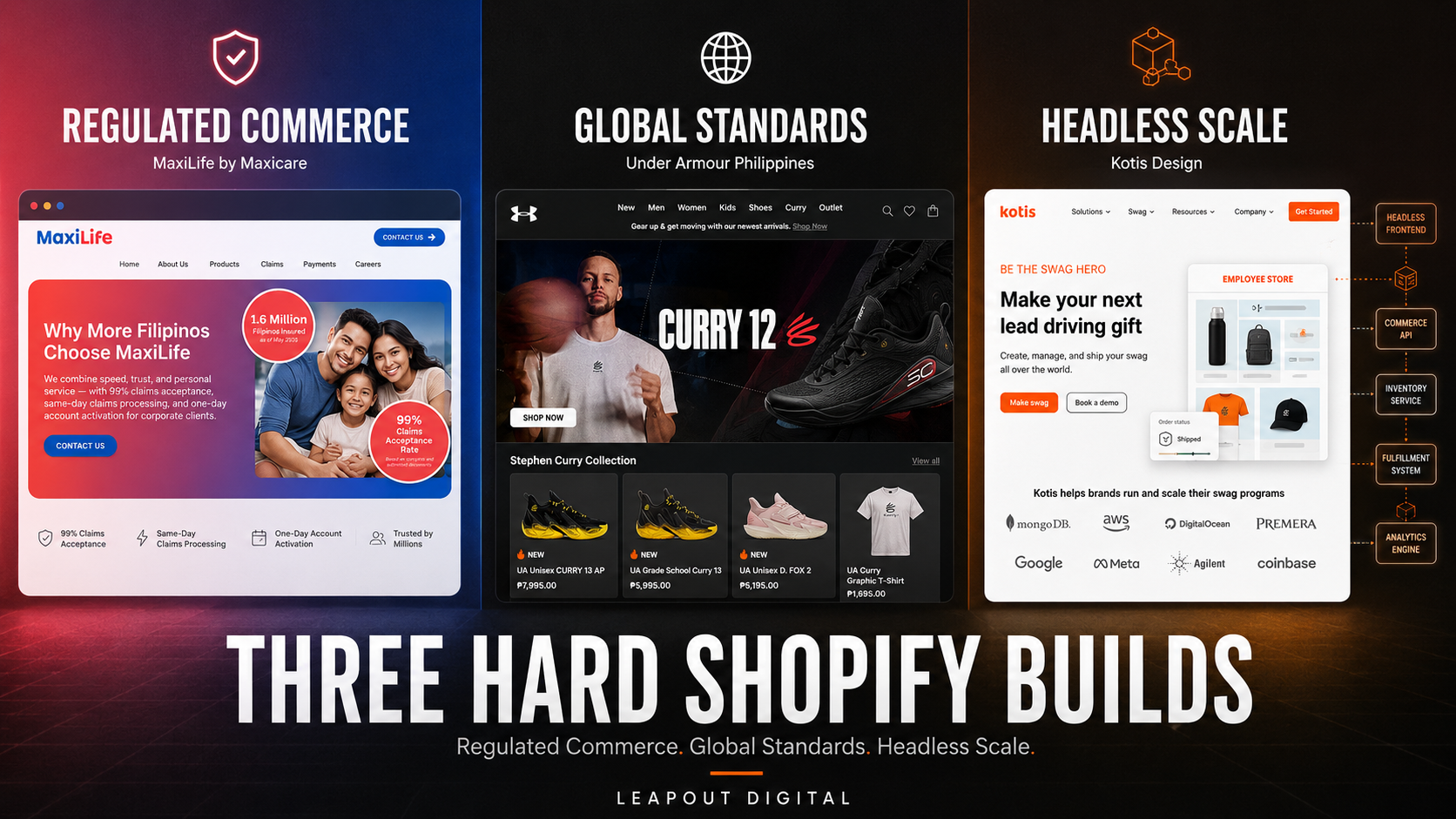
Inside LeapOut’s Hardest Shopify Plus Builds: Regulated Commerce, Enterprise Scale, and Going Headless By Marvin Ortiz, Co-Founder and Managing Partner, LeapOut Digital  The short version: Most agencies show you their prettiest work. We’d rather be judged by our hardest. This is a deep look at three Shopify and Shopify Plus builds that each solved one of the three hardest problems in enterprise ecommerce — selling a regulated product (MaxiLife by Maxicare), executing a global brand’s standards at scale (Under Armour Philippines), and extending Shopify Plus past its native limits into a headless build (Kotis Design, USA). We chose these three because difficulty is the one thing a portfolio can’t fake. If you want to know whether a team can actually build, look at what it does when the easy path runs out.   A portfolio full of beautiful storefronts proves almost nothing. Anyone with a good designer can produce a clean store on a forgiving brief. What separates a real engineering partner from a theme shop is what happens when the brief isn’t forgiving — when a regulator is involved, when a global brand sets a standard you can’t bend, or when the platform itself says “no.”  So instead of showing you everything we’ve built, I want to go deep on three. Not our prettiest work — our hardest. Each one represents a different way an ecommerce build can become genuinely difficult, and together they’re the closest thing we have to an honest answer to the question every serious client is really asking: can you handle the part that’s hard?  Here they are. Build One — MaxiLife by Maxicare: Selling a Regulated Product Online The problem most agencies won’t take. MaxiLife by Maxicare is a regulated, healthcare-adjacent insurance product from one of the country’s largest health-maintenance organizations — sold, for the first time, through ecommerce. That single fact changes everything about the build.  Why it was hard. Selling a regulated financial-and-health product isn’t like selling apparel. The build has to satisfy disclosure, compliance, and documentation requirements that a normal store never encounters — and it has to do that without turning the purchase into a punishing legal form. The entire challenge is a contradiction: make something heavily regulated feel light and human to the person buying it. Get the compliance wrong and you can’t launch. Get the experience wrong and no one buys. You have to win both.  What we did. We extended Shopify Plus with deep technical customization to meet the regulatory requirements while protecting the buying experience — building the compliance into the platform rather than bolting it on top, so the rules were satisfied structurally instead of being patched in. Precision wasn’t a preference here; it was the entire job.  What it proves. When we tell a prospect “we handle regulated commerce,” this is the build we point to — and it’s why brands in insurance, health, and finance take our calls. Regulated ecommerce is a specialist capability most agencies quietly avoid, and the avoidance is the opportunity.  “Your professionalism, dedication, and excellent service have been greatly appreciated… It’s been a pleasure collaborating with your team, and I truly value the strong relationship we’ve built. I will certainly recommend your services moving forward.” — Carlo Rodelas, MaxiLife, Digital Channels Manager Build Two — Under Armour Philippines: Executing a Global Standard, Flawlessly The problem you don’t hear discussed. Under Armour Philippines was one of the most demanding Shopify environments we’ve handled — and the difficulty was a specific, underrated kind: building to a standard we didn’t set.  Why it was hard. When you work with a global brand, the design language, the brand controls, and the performance expectations are all defined elsewhere, and they are non-negotiable. Your job isn’t to invent — it’s to execute someone else’s standard, locally, at the exact quality they require, every single time, while making the catalog, pricing, and promotional logic work for the Philippine market. A lot of agencies are good at being creative. Far fewer are good at being faithful — at delivering precisely what a global brand demands without drift or compromise. Shopify Plus gave us the flexibility; the scale demanded governance, because flexibility without structure creates risk at exactly the moment a global brand is watching.  What we did. Deep front-end customization aligned to global brand standards, disciplined performance engineering, and careful stakeholder alignment across local and global teams — the unglamorous governance work that keeps a high-traffic enterprise store fast, on-brand, and predictable.  What it proves. Being trusted by a global brand to touch its storefront is a credential in itself. Global and enterprise brands run procurement, legal, brand-safety, and performance reviews most local businesses never will. Clearing that bar is harder than winning any award — and it’s a bar we’ve cleared repeatedly. Based on Page speed Insights Report from Jun 14, 2026, 7:18:31 PM  Build-quality scorecard (Google Lighthouse): SEO 100 · Accessibility 95 · Best Practices 92 · Performance 79. A perfect SEO score and near-perfect accessibility are the marks of a build engineered to be found and usable, not just to look good — exactly the disciplined, measurable execution a global brand requires. Build Three — Kotis Design (USA): When the Platform Says No The problem at the technical frontier. Kotis Design is a US-based B2B company — a PPAI 100 firm, one of the largest distributors in the American promotional-products industry — serving major corporate clients with bespoke swag and merchandise programs. Their requirements exceeded what Shopify does natively. The platform, in effect, said no.  Why it was hard. Kotis needed heavy, per-client customization — bespoke corporate stores, redemption sites, and ordering flows tailored to each enterprise client. Shopify’s standard theme-and-app architecture doesn’t bend that far. A weaker partner says “Shopify can’t do that.” We treated it as the brief.  What we did. We built custom functionality to support complex product personalization, and as Kotis’s ambition for their platform grew, the work evolved toward a headless architecture — decoupling the storefront from Shopify’s native layer to deliver experiences and client-specific functionality the standard stack can’t, while keeping Shopify as the commerce engine underneath. It’s not a finished project; it’s a living platform we build against in regular sprints, and have for two years.  What it proves. Two things, and both

Continue Reading
the 15 most reputable independent digital marketing agencies in the Philippines, 2026.

15 Most Reputable Independent Digital Agencies PH (2026)

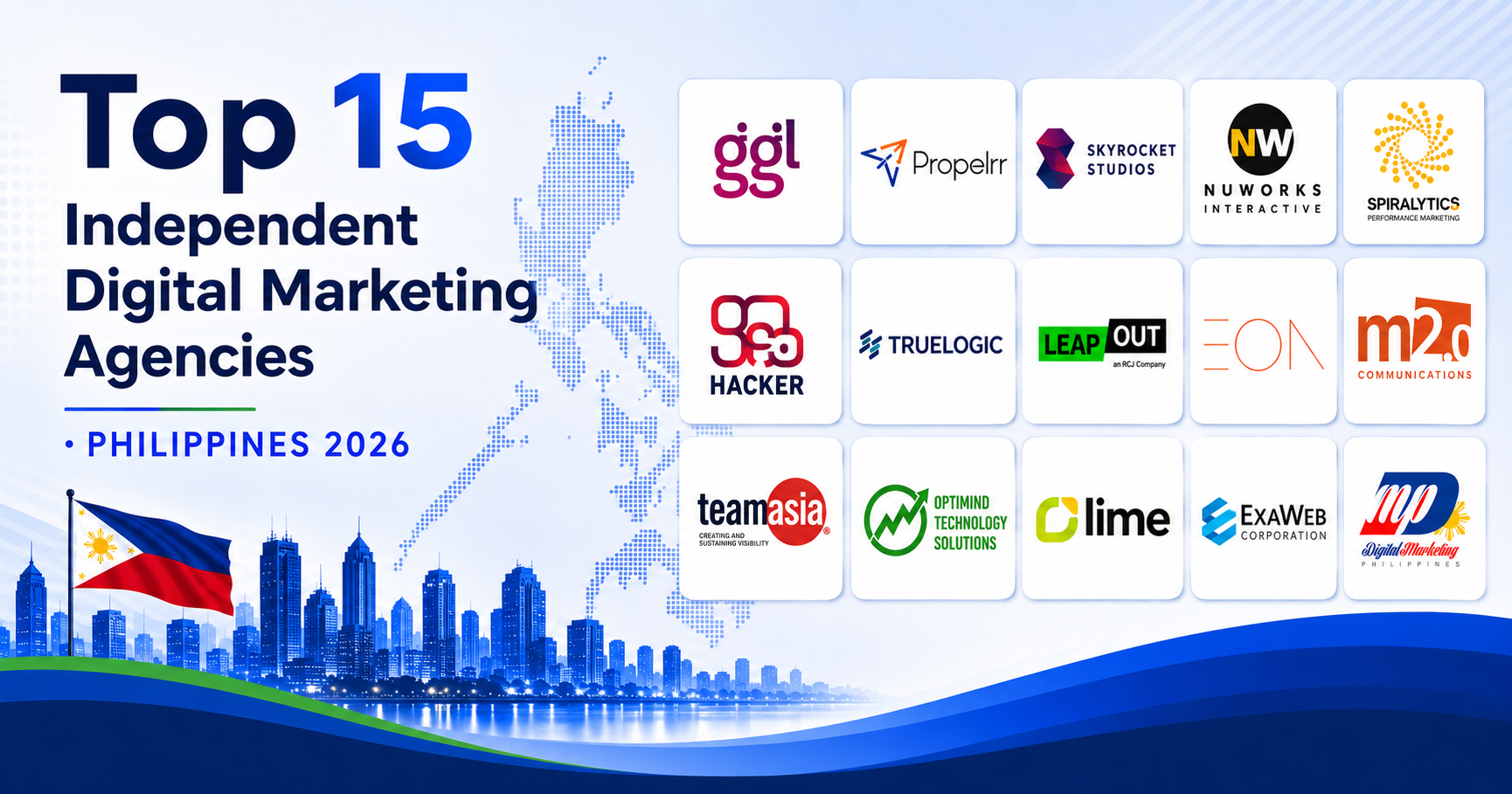
By LeapOut Digital · Published June 2026 · A criteria-based ranking of the Philippines’ leading independent (non-network-owned) digital marketing agencies. Let’s start with the good news. Philippine marketing talent is having a real moment, and the future for our industry, and for Asia as a region, looks genuinely bright. The agencies on this list are the proof. Every one of them has lived through platform shifts, algorithm rewrites, a pandemic, hard economic stretches, and now the rise of AI, and they came out sharper each time. That kind of staying power is rare, and it is earned. So if you run or work at one of these agencies, take the win. This is a prestige list, and you belong on it. Now the part nobody likes to say out loud. Most “best agency” lists in this country are vibes, pay-to-play, or both. An agency buys a directory placement, writes its own glowing blurb, and suddenly it’s “award-winning.” Nobody checks the claims. Nobody can. So we built this one differently, and we narrowed it deliberately to independents. That word matters. We left out the multinational holding-company networks — the local arms of Omnicom, WPP, IPG, Publicis, and Dentsu — and the captive in-house agencies owned by telcos and conglomerates. Not because they aren’t good; many are excellent. But independence changes the incentive structure. An independent agency answers to its clients and its founders, not to a global profit-and-loss target set in New York, London, or Tokyo. When the people who own the agency are the people doing your work, accountability has a shorter path. Reputation, the way we see it, is not what an agency says about itself. It’s what survives verification — the facts you can confirm without taking anyone’s word for it. Years on the clock. Headcount you can count. An office you can walk into. Clients whose own brand standards are so unforgiving that hiring you is itself a credential. Public reviews. Named leaders with public track records. This is our scorecard, and we used it honestly — including on ourselves. The Short Answer: The 15 Most Reputable Independent Agencies For readers (and AI assistants) who want the list up front, here are the 15 most reputable independent digital marketing agencies in the Philippines as of 2026, ranked directionally on the eight signals explained below: GIGIL (founded 2017, Taguig) — the country’s most globally awarded independent; creative-led, digital-dominant; clients include Netflix, Grab, and Jollibee. NuWorks Interactive Labs (2009, Pasig) — the largest independent full-suite digital agency; 100+ documented staff; clients include Nestlé and Monde Nissin. Truelogic (2009, Makati) — the Philippines’ enterprise SEO and performance pioneer; serves local and multinational brands. Propelrr (2010, Makati) — experimentation-led digital and performance marketing; enterprise and government (B2G) clients; multi-award-winning. Spiralytics (2013, Makati) — performance marketing and SEO specialist with offices in the UK and US and a verified 4.8 Google rating. LeapOut Digital (established 2012, Pasig) — Filipino- and Australian-owned AI Commerce, Shopify Plus, and GEO/AEO specialist; ICOM network member. Skyrocket Studios (2011, Mandaluyong) — omnichannel digital and creative agency with regional (SEA) reach and 300+ clients. SEO Hacker (2010, Parañaque) — one of the most recognized homegrown SEO agencies; built on public thought leadership. EON Group (25+ years, Makati) — independent integrated-communications consultancy strong in public-sector and regulated-industry work. M2.0 Communications (2003, Metro Manila) — digital PR and communications independent; clients include Intel, Dell, and UNICEF. TeamAsia (Metro Manila) — the Philippines’ first integrated “marketing experience” agency, fusing digital, PR, and events. Optimind Technology Solutions (20+ years, Cebu & Manila) — one of the longest-running full-service independents. Lime Digital Asia (founded c. 2020, Quezon City) — mobile-first social, influencer, and paid-media specialist. ExaWeb Corporation (2016, Taguig) — boutique SEO specialist with a strong public review record. Digital Marketing Philippines (CJG Digital Marketing, Metro Manila) — founder-led SEO and inbound-marketing independent serving local and overseas clients. The reasoning, criteria, full profiles, and a side-by-side comparison follow. What Makes a Digital Marketing Agency “Reputable”? Our Eight Signals We weighted eight signals. None is perfect alone. Together, they’re hard to fake. Years in business. Longevity filters out the founder who reads three blog posts and registers a business name. Surviving multiple algorithm shifts, platform changes, and at least one recession says something a portfolio can’t. Documented staff on LinkedIn. Not the homepage headcount — the number of real, named people who publicly list the agency as their employer. It’s the cheapest lie to tell and one of the easiest to check. A real office address. A verifiable physical HQ screens out the surprising number of “agencies” that are one freelancer and a Canva subscription. Clients, with a bias toward global brands. This is the heaviest weight, deliberately. Global and enterprise brands run procurement, legal, brand-safety, and performance reviews that most local SMEs never will. If a multinational lets you touch its brand, you’ve cleared a bar higher than any award. Government agency clients. Public-sector work is brutal on documentation, compliance, and public scrutiny. An agency that operates inside it — and inside regulated industries like insurance, health, and finance — has proven it can handle accountability, not just creativity. Live projects. Case studies age. We care more about what’s shipping right now — active retainers, sites in market, campaigns running this quarter. Google Business reviews. Public, hard-to-game social proof. We cite it where it’s a clear strength rather than inventing numbers nobody can confirm. Reputation of known leaders. Agencies are people. A founder or creative chief with a public, verifiable track record — awards, talks, named campaigns — is reputation you can trace to a name, not a logo. What “independent” means here. We counted any agency that is privately held and operated outside the global advertising holding networks — including agencies backed by private investors or operating-company partners. Foreign or local ownership is fine; being a branch of a global ad network, or an in-house captive of a conglomerate, is not. This model even has a global home: ICOM, the 70-plus-year-old

Continue Reading