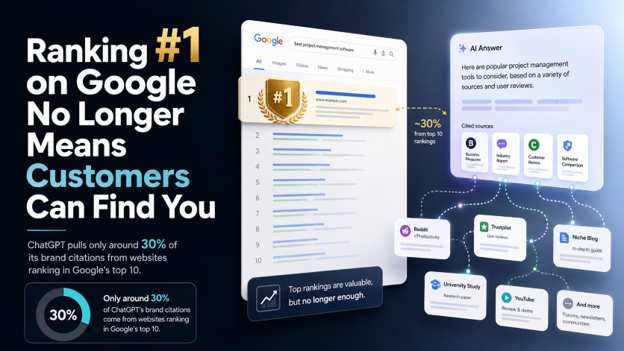
ChatGPT pulls only around 30% of its brand citations from websites ranking in Google’s top 10.
Read that again if your company still considers SEO “done” once it reaches page one.
For more than twenty years, search visibility had one scoreboard. You ranked or you didn’t. Agencies built retainers around keyword positions, marketing teams built budgets around organic traffic, and everyone agreed on what winning looked like: page one, preferably position one.
That scoreboard didn’t get an update. It fragmented. Your business can rank well on Google and still be absent when a customer asks ChatGPT, Gemini, or Perplexity for a recommendation. You can be visible in search and invisible in the conversation.
The quick answer
Ranking first on Google is still valuable — but it no longer guarantees visibility across AI-powered search.
Google Search, Google AI Overviews, Google AI Mode, ChatGPT, Gemini, and Perplexity each use different systems to retrieve, evaluate, and present information. A strong Google ranking influences some of them. It controls none of them.
Businesses now need to answer three separate questions:
- Does Google rank us?
- Do people still click and visit us?
- Do AI platforms mention, cite, or recommend us?
If your reporting only answers the first question, you’re working from an incomplete scoreboard.
The number marketers should sit with
Benchmark data published by AI-visibility platform CiteLens, and reported by MarketScale, found that Google AI Mode and Perplexity draw roughly 90% of their brand citations from websites in Google’s conventional top-10 results. Your existing SEO still buys you a seat at those tables.
ChatGPT draws only around 30% from that same pool.
This is one platform’s benchmark, not a universal law for every query, country, and industry. But the commercial implication is hard to ignore: the most-used AI assistant in the world is sourcing roughly 70% of its answers from somewhere your rank tracker doesn’t look. A brand can rank first, generate millions of impressions, and look successful in a traditional SEO report — while being excluded from the answer its next customer actually receives.
Google ranking and AI recommendation are related. They are not the same thing.
What our own data shows: ranked, but bypassed
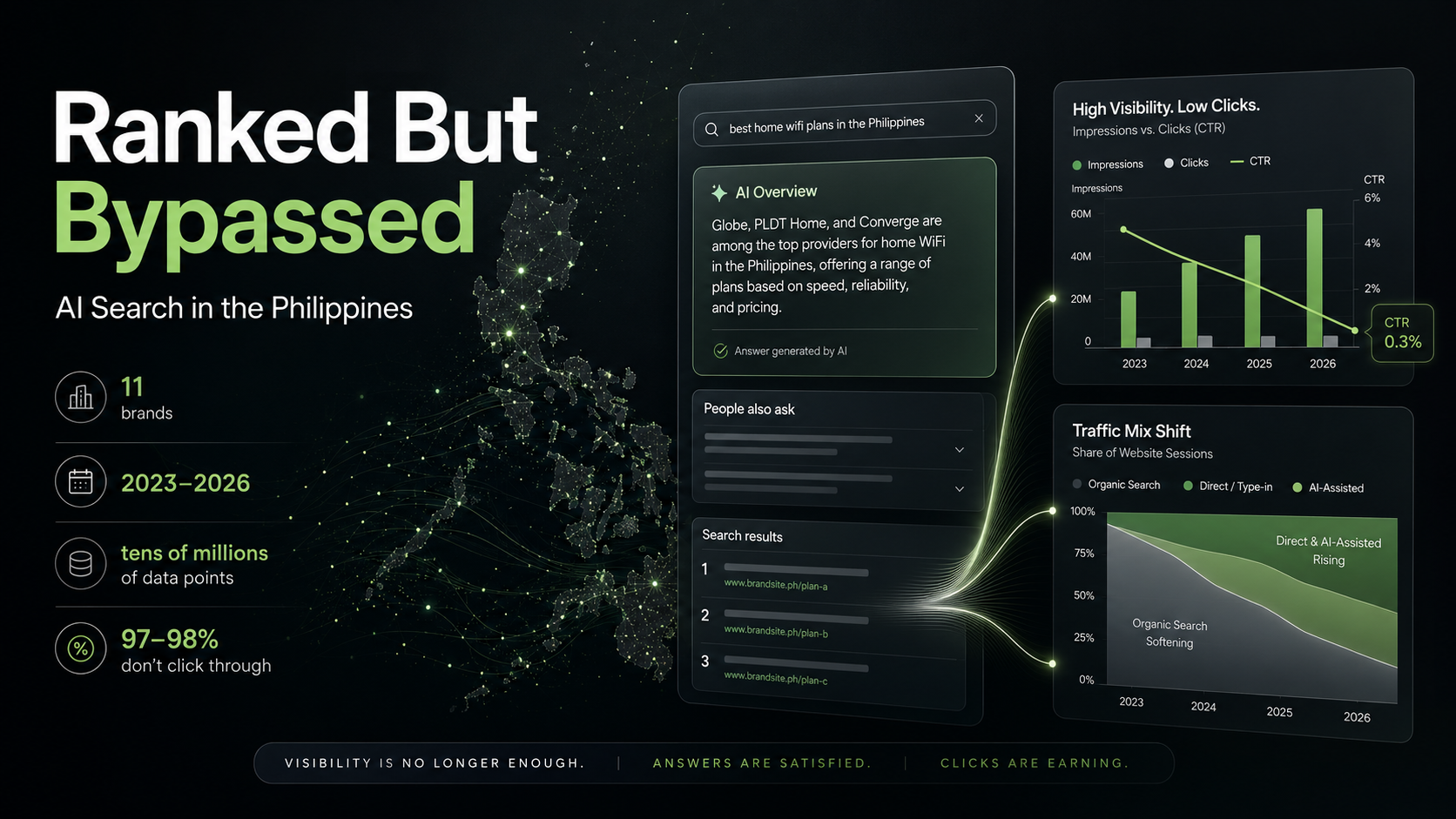
LeapOut Digital’s 2026 study, Ranked But Bypassed, examined anonymised first-party Google Analytics 4 and Google Search Console data from 11 brands across the Philippines, Australia, North America, and South Africa — three and a half years of data, from January 2023 to June 15, 2026. Seven of the businesses were Philippine brands across six industry categories.
Four brands had Google Search Console data available, representing a combined 59 million Google search impressions over 12 months. Here’s what that data showed.
The rankings held. There was no collapse. These brands kept appearing on the first or second page of Google for the searches that matter to them — two Philippine brands held average positions around 8.6 and 9.1, and one generated roughly 35 million Google impressions in a single year.
The clicks didn’t follow. Click-through rates across the four brands ranged from just 1.6% to 2.3%. Those 59 million impressions produced fewer than 1.3 million website visits.
In practical terms: roughly 97 to 98 out of every 100 people who saw these brands in Google Search never visited their websites.
To be clear about what the study does and doesn’t claim — it does not prove AI caused the entire gap. AI Overviews, featured snippets, People Also Ask boxes, query intent, and brand awareness all influence click-through rates. What the data establishes is a pattern businesses can no longer ignore: this isn’t an invisibility problem. It’s a conversion-of-visibility problem. The brand shows up; the searcher goes somewhere else — or gets their answer without going anywhere at all.
AI-referred traffic is already showing up in Philippine analytics
One more finding worth flagging. The “AI Assistant” acquisition channel appeared for the first time in the 2026 data of six brands in the study — five of them Philippine brands. Volumes were small, between 1 and 89 users per brand in the first half of 2026.
Small, but significant. It confirms that users are already arriving at Philippine brand websites through ChatGPT, Gemini, Perplexity, and Copilot. AI-assisted discovery isn’t something to prepare for someday — it’s already measurable in local analytics. And every major digital channel in history started as a rounding error before it became a budget line.
Search didn't disappear. It splintered.
Most marketing teams still run a mental model of “Google Search, with AI added on top.” The reality is a dozen distinct answer surfaces: traditional Google Search, AI Overviews, AI Mode, ChatGPT, Gemini, Perplexity, Claude, Copilot, plus industry-specific assistants and social and ecommerce search. Each has its own retrieval systems, ranking signals, citation logic, and source preferences.
Your Google position influences some of them. It is not a master key to all of them.
This matters especially in the Philippines, where many companies are still strengthening traditional SEO foundations while customer behaviour is already moving toward conversational discovery. People aren’t just typing short keywords anymore — they’re asking complete commercial questions:
- “What’s the best Shopify agency in the Philippines?”
- “Which digital marketing agencies in Manila work with Australian companies?”
- “Which agency can help a Philippine brand become visible in ChatGPT?”
- “Which Philippine agency offers global-quality execution at a competitive cost?”
The business named in the AI-generated answer may not be the business ranking first on Google. And when your brand is absent, the platform doesn’t leave the answer blank. It recommends someone else.
What is AI search visibility?
AI search visibility measures how frequently and prominently a brand appears in AI-generated answers. That includes being directly recommended, included in a shortlist, cited as a source, referenced in comparisons, or having your research and experts quoted to support an answer — and, just as importantly, whether your competitors appear when you don’t.
The discipline goes by several names — Answer Engine Optimisation (AEO), Generative Engine Optimisation (GEO), AI Search Optimisation. The industry can keep debating terminology. The business question is simpler:
When a customer asks an AI platform a relevant question, does your brand appear in the answer?
From experiment to discipline
A year ago, the only way to check AI visibility was to manually type questions into ChatGPT. By mid-2026, it’s a software category: multiple competing platforms, self-serve plans, enterprise contracts, and engine-by-engine reporting covering brand mentions, citation frequency, competitor share of voice, sentiment, prompts that trigger mentions, and AI crawler activity.
The metrics aren’t perfect. AI answers vary between runs, and visibility scores require repeated testing rather than one-off checks. But the direction is unmistakable: the market is moving from experimentation to measurement. And once a channel becomes measurable, companies start assigning budgets, targets, and owners to it. Money is the market’s way of confirming a discipline.
SEO isn't dead. It's just no longer the whole scoreboard.
The answer is not to abandon SEO — it’s to expand what SEO is expected to accomplish.
Google states that its generative AI search experiences are grounded in its core Search ranking and quality systems, and that no special AI schema or secret technical shortcut is required to appear in AI Overviews or AI Mode. The fundamentals still matter: crawlable and indexable pages, helpful original content, clear titles and headings, accurate structured data, credible external mentions, current information.
What changed is the assumption underneath. You can no longer treat Google ranking as equal to total digital visibility. A more complete model:
SEO creates discoverability. Authority creates trust. Clear information creates citability. Third-party validation creates recommendation visibility.
Businesses increasingly need all four.
How ChatGPT, Gemini, and Perplexity actually discover websites
No formula guarantees visibility on every platform. But you should at least confirm the platforms can reach and understand your site.
ChatGPT. OpenAI uses OAI-SearchBot to surface websites in ChatGPT search results. Blocking it can exclude you from ChatGPT search answers. Note that OAI-SearchBot is separate from GPTBot, which crawls content for model training — you can allow search access while restricting training access.
Gemini and Google AI features. AI Overviews and AI Mode draw from the Google Search index and Google’s existing ranking systems. To be eligible, a page needs to be crawlable, indexed, and able to appear in Google Search. No AI-only schema exists.
Perplexity. Perplexity uses PerplexityBot to discover and link websites. Check that your robots.txt and security systems aren’t unintentionally blocking it.
Technical access doesn’t guarantee a citation. But if a platform can’t consistently reach your website, you’ve lost before your content is even evaluated.
What makes content citable
AI platforms are effectively deciding three things about every page: What is this about? Can it be trusted? Does it answer the question? You can make those decisions easier.
Give the answer early. Don’t bury the point under five paragraphs of setup. State the answer near the top, then build the context, evidence, and caveats. AI platforms often retrieve individual passages rather than whole articles, so each important section should stand on its own.
Be specific about who you are. Name your company, where you operate, what you do, who you serve, and the experience behind your claims — with a named author and a visible date. “We help brands grow through innovative digital solutions” tells a platform nothing. “LeapOut Digital is a Philippine-based digital marketing and technology agency helping ecommerce and service businesses improve AI search visibility, SEO, Shopify performance, paid media, and website conversion” tells it everything.
Publish original evidence. AI platforms don’t need another article repeating what a thousand websites already say. They need first-party data, local market research, detailed case studies, named methodologies, and first-hand implementation experience. The strongest AI-search content isn’t content designed to sound intelligent — it’s content containing information worth citing.
The Branded Content Principle
The Ranked But Bypassed study surfaced one more pattern: the more resilient brands were supported by strong branded and informational content. People weren’t only searching generic categories — they were searching for brand-specific recipes, product specifications, use cases, and guides.
A generic question like “What’s the best karaoke machine?” can be answered from whichever sources an AI platform happens to trust. A question involving your specific brand, product, feature, or framework is far more defensible. Which leads to what we call the Branded Content Principle:
Content connected to your brand’s unique knowledge, products, experience, and data is more resilient than generic content any competitor can publish.
For LeapOut, that means original research on AI search behaviour in the Philippines, client case studies, and frameworks built from real implementation work. For your company, it might be proprietary product data, recipes, technical specifications, customer research, or local market knowledge. The goal is not to publish more articles. The goal is to become the most credible original source for a clearly defined subject.
Why the window is now
Every measurable channel follows the same arc: invisible → measurable → crowded → expensive. Email did it. Social did it. Paid search did it, painfully. Traditional SEO did too.
AI search visibility is sitting at the rarest point on that curve: measurable, but still uncrowded in most industries. The tools exist. The early benchmarks exist. Customer behaviour is already shifting — our own analytics data proves it. Yet most brands and agencies still file this under “SEO add-on” or “next year’s planning cycle.”
That delay is the opening. The companies that benefit most over the next 12 to 18 months won’t necessarily be the ones with the biggest budgets. They’ll be the ones that started earlier — because AI platforms are already answering questions about your industry, already comparing providers, already recommending someone. The only question is whether your brand is shaping those answers.
What to do this quarter
Not next year. This quarter.
- Ask the platforms what they know about you. Open ChatGPT, Gemini, and Perplexity and ask the questions your customers ask: What are the leading companies in our category? Which providers would you recommend in the Philippines? How does our company compare with competitors? Record whether you’re mentioned, recommended, cited, described accurately, compared against the right competitors — or missing entirely. This audit is manual and free, and most business owners won’t like what they find. That’s exactly why it matters.
- Separate the scoreboards. Don’t bury AI visibility as one slide in a traditional SEO report. Rankings, AI citations, and recommendation visibility are connected but not interchangeable. Track Google rankings, impressions, clicks, and CTR separately from AI Overview visibility, per-engine mentions and citations, competitor share of AI answers, and AI-referred traffic. Averaging them into one score produces a clean report that hides what’s actually happening.
- Establish a baseline. Choose 20 to 50 questions that reflect your real customer journey — discovery, recommendations, comparisons, pricing, location, high-intent buying decisions. Run them consistently across the relevant platforms. Answers vary between runs, so look for patterns over repeated tests, not proof in a single result. You need a baseline today to prove movement next quarter.
- Read your analytics for changing behaviour. Prompt tracking isn’t enough. In GA4 and Search Console, watch AI Assistant traffic, organic share, direct and unassigned traffic, impressions, clicks, CTR, average position — and especially the gap between impressions and clicks. No single metric proves AI changed the journey (direct traffic also contains bookmarks, dark social, and attribution gaps). But when rankings and impressions hold steady while clicks decline, and AI Assistant or unassigned traffic rises, you have a pattern worth investigating.
- Fix the pages that answer commercial questions. Your website should plainly state what you do, who you serve, where you operate, why you’re credible, what results you’ve produced, and how you differ. Many websites look impressive and say very little. AI platforms cannot confidently recommend a company whose capabilities are hidden behind vague headlines and brand language.
- Publish proof, not just opinions. Build content around real customer decisions: SEO versus AI search optimisation, how to measure ChatGPT brand visibility, what to look for in an ecommerce development partner, what digital marketing costs in the Philippines, original case studies with measurable results. Content should help someone make a decision — not prove your company can publish articles.
- Assign an owner. What nobody owns rarely improves. SEO, content, PR, development, and brand leadership may all contribute, but one person must be accountable for monitoring priority questions, checking accuracy, coordinating content improvements, reviewing crawler access, and reporting commercial impact. Disciplines without owners become footnotes — which is how this became a blind spot in the first place.
Frequently asked questions
Yes. A company can rank strongly in traditional Google results yet appear rarely — or not at all — when ChatGPT answers recommendation, comparison, or buying questions. Google rankings are not a substitute for measuring ChatGPT visibility directly.
Yes. SEO remains the foundation — it drives crawlability, discoverability, authority, and content quality. But strong Google rankings do not guarantee that every AI platform will mention, cite, or recommend a brand.
No. Google says there is no AI-only schema or technical requirement for appearing in AI Overviews or AI Mode. Existing SEO fundamentals apply: crawlability, indexability, useful content, accurate structured data, and strong page experience.
SEO focuses on visibility in traditional search-engine results. GEO focuses on mentions, citations, and recommendations inside AI-generated answers. The disciplines overlap substantially but are measured differently and may require different content, authority, and reporting strategies.
Make the website accessible to relevant AI crawlers, define the business and its services in specific language, answer customer questions directly, demonstrate first-hand expertise, publish original research and data, earn credible third-party mentions, and measure visibility across multiple platforms over time.
With a consistent set of customer questions run repeatedly across relevant platforms, tracking brand mentions, citations, recommendations, competitor presence, and answer accuracy over time. One manual search is not a measurement programme.
The bottom line
Ranking first on Google is still valuable. It’s just no longer the entire game.
Our first-party research shows brands can keep earning millions of Google impressions and respectable rankings while the relationship between visibility and website visits quietly weakens. The study doesn’t prove AI is solely responsible. It does prove that measuring rankings alone is no longer sufficient.
A modern visibility strategy answers three separate questions: Does Google rank us? Do people still choose to visit us? Do AI platforms cite or recommend us?
So ask ChatGPT, Gemini, and Perplexity the questions your customers are asking. See whether your company appears, which competitors get recommended, and which sources shape the answer. Then compare that against what your rankings report is telling you.
Because your company may still be ranked. It may also already be getting bypassed.
Sources and further reading
- LeapOut Digital: Ranked But Bypassed: What 11 Brands and Tens of Millions of Data Points Reveal About AI Search in the Philippines
- MarketScale: AI Answer-Engine Visibility Becomes a Measurable Discipline as GEO Platforms Multiply in 2026
- Google Search Central: Optimizing Your Website for Generative AI Features on Google Search
- OpenAI: Overview of OpenAI Crawlers
- Perplexity: Perplexity Crawlers