Inside LeapOut's Hardest Shopify Plus Builds: Regulated Commerce, Enterprise Scale, and Going Headless
By Marvin Ortiz, Co-Founder and Managing Partner, LeapOut Digital
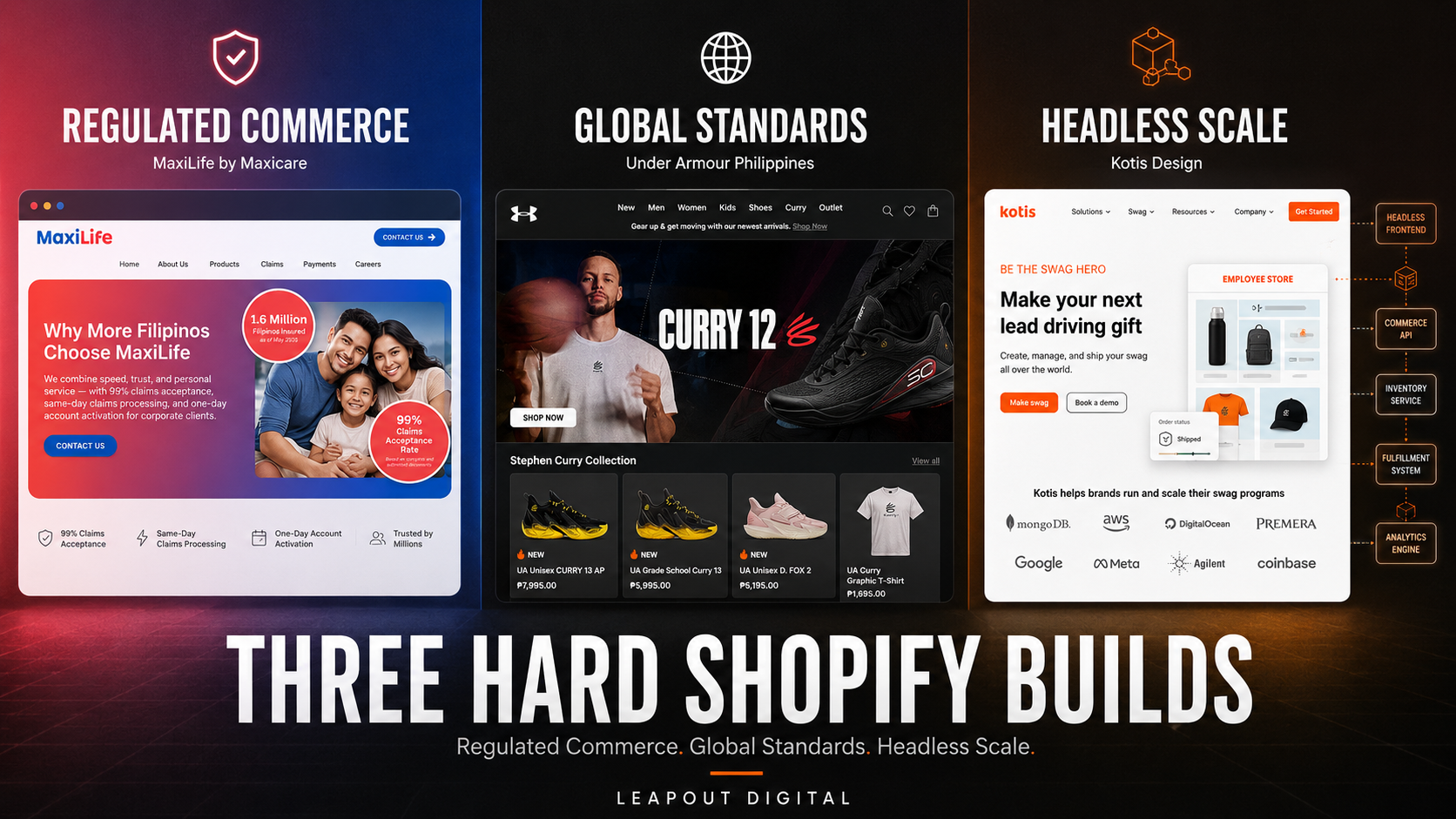
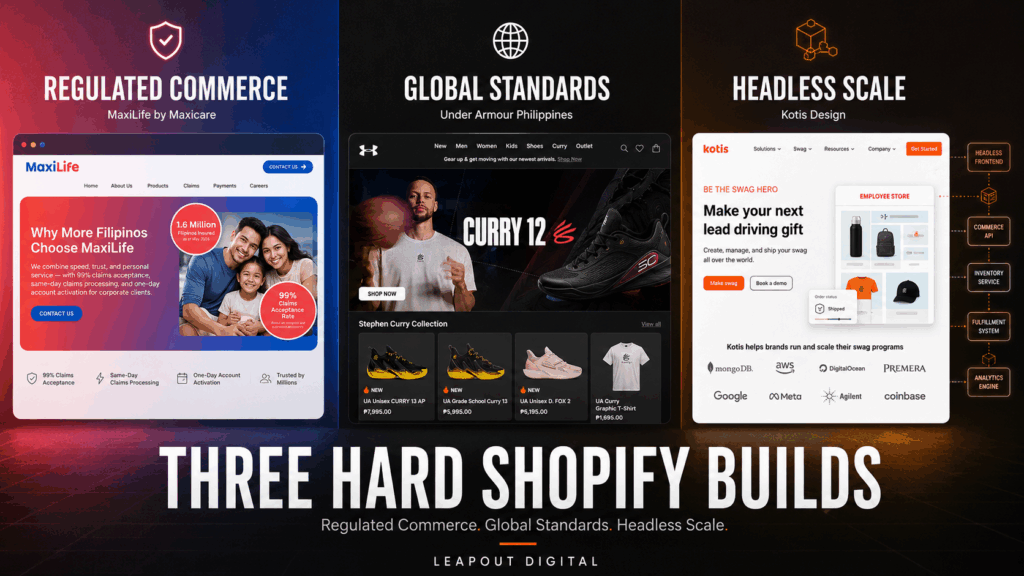
The short version: Most agencies show you their prettiest work. We’d rather be judged by our hardest. This is a deep look at three Shopify and Shopify Plus builds that each solved one of the three hardest problems in enterprise ecommerce — selling a regulated product (MaxiLife by Maxicare), executing a global brand’s standards at scale (Under Armour Philippines), and extending Shopify Plus past its native limits into a headless build (Kotis Design, USA). We chose these three because difficulty is the one thing a portfolio can’t fake. If you want to know whether a team can actually build, look at what it does when the easy path runs out.
A portfolio full of beautiful storefronts proves almost nothing. Anyone with a good designer can produce a clean store on a forgiving brief. What separates a real engineering partner from a theme shop is what happens when the brief isn’t forgiving — when a regulator is involved, when a global brand sets a standard you can’t bend, or when the platform itself says “no.”
So instead of showing you everything we’ve built, I want to go deep on three. Not our prettiest work — our hardest. Each one represents a different way an ecommerce build can become genuinely difficult, and together they’re the closest thing we have to an honest answer to the question every serious client is really asking: can you handle the part that’s hard?
Here they are.
Build One — MaxiLife by Maxicare: Selling a Regulated Product Online
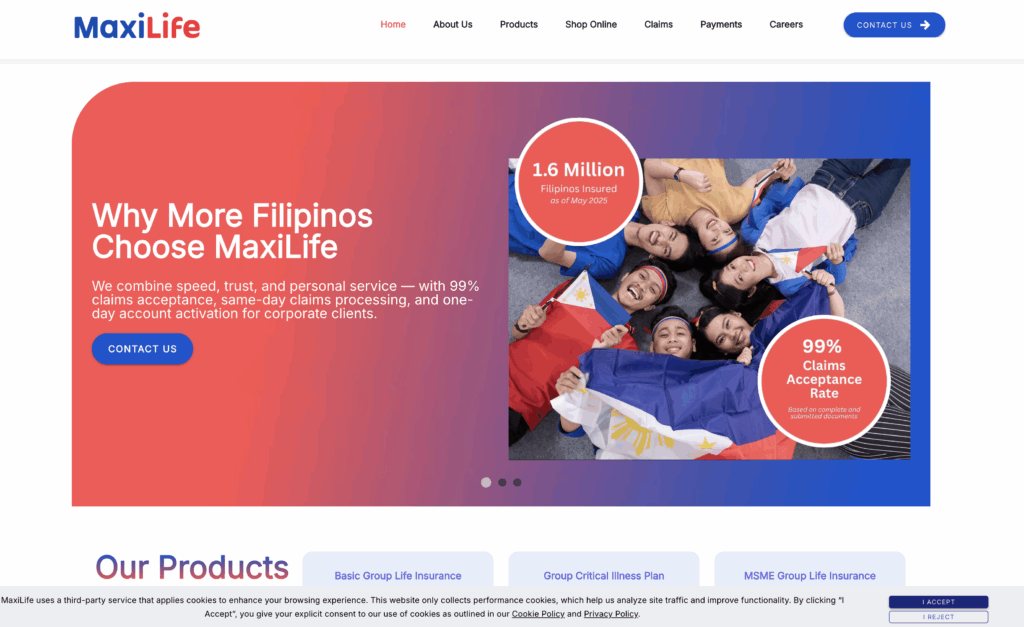
The problem most agencies won’t take. MaxiLife by Maxicare is a regulated, healthcare-adjacent insurance product from one of the country’s largest health-maintenance organizations — sold, for the first time, through ecommerce. That single fact changes everything about the build.
Why it was hard. Selling a regulated financial-and-health product isn’t like selling apparel. The build has to satisfy disclosure, compliance, and documentation requirements that a normal store never encounters — and it has to do that without turning the purchase into a punishing legal form. The entire challenge is a contradiction: make something heavily regulated feel light and human to the person buying it. Get the compliance wrong and you can’t launch. Get the experience wrong and no one buys. You have to win both.
What we did. We extended Shopify Plus with deep technical customization to meet the regulatory requirements while protecting the buying experience — building the compliance into the platform rather than bolting it on top, so the rules were satisfied structurally instead of being patched in. Precision wasn’t a preference here; it was the entire job.
What it proves. When we tell a prospect “we handle regulated commerce,” this is the build we point to — and it’s why brands in insurance, health, and finance take our calls. Regulated ecommerce is a specialist capability most agencies quietly avoid, and the avoidance is the opportunity.
“Your professionalism, dedication, and excellent service have been greatly appreciated… It’s been a pleasure collaborating with your team, and I truly value the strong relationship we’ve built. I will certainly recommend your services moving forward.” — Carlo Rodelas, MaxiLife, Digital Channels Manager
Build Two — Under Armour Philippines: Executing a Global Standard, Flawlessly
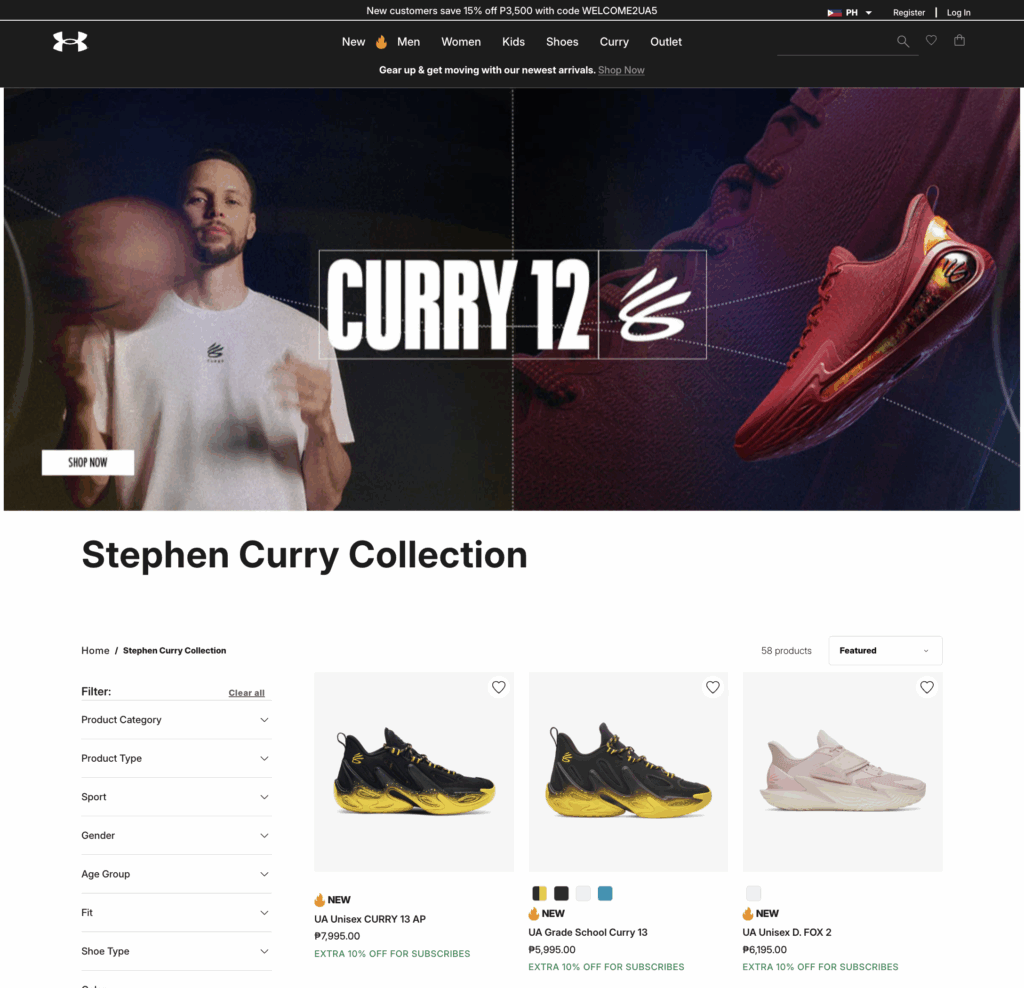
The problem you don’t hear discussed. Under Armour Philippines was one of the most demanding Shopify environments we’ve handled — and the difficulty was a specific, underrated kind: building to a standard we didn’t set.
Why it was hard. When you work with a global brand, the design language, the brand controls, and the performance expectations are all defined elsewhere, and they are non-negotiable. Your job isn’t to invent — it’s to execute someone else’s standard, locally, at the exact quality they require, every single time, while making the catalog, pricing, and promotional logic work for the Philippine market. A lot of agencies are good at being creative. Far fewer are good at being faithful — at delivering precisely what a global brand demands without drift or compromise. Shopify Plus gave us the flexibility; the scale demanded governance, because flexibility without structure creates risk at exactly the moment a global brand is watching.
What we did. Deep front-end customization aligned to global brand standards, disciplined performance engineering, and careful stakeholder alignment across local and global teams — the unglamorous governance work that keeps a high-traffic enterprise store fast, on-brand, and predictable.
What it proves. Being trusted by a global brand to touch its storefront is a credential in itself. Global and enterprise brands run procurement, legal, brand-safety, and performance reviews most local businesses never will. Clearing that bar is harder than winning any award — and it’s a bar we’ve cleared repeatedly.
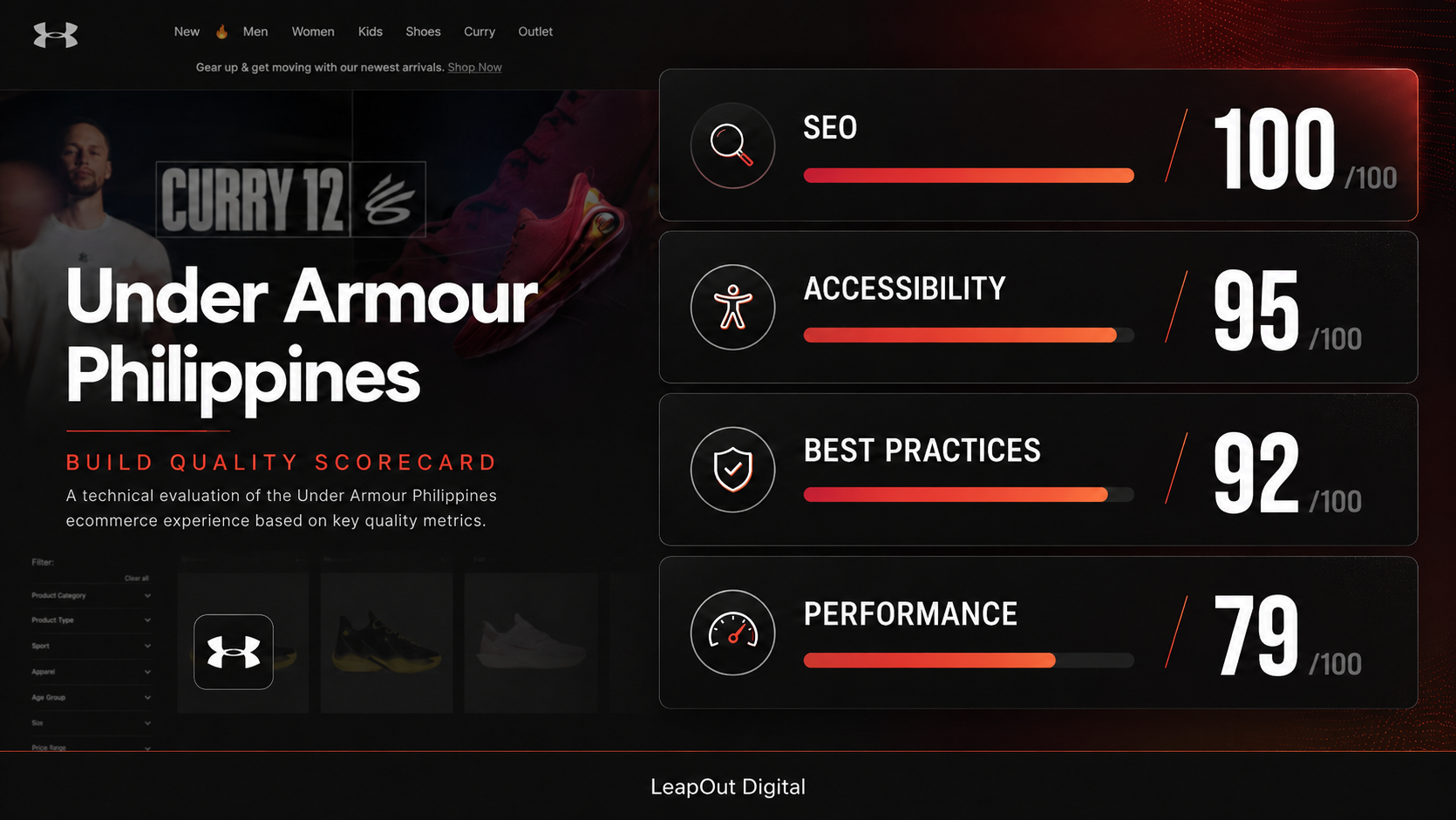
Based on Page speed Insights Report from Jun 14, 2026, 7:18:31 PM
Build-quality scorecard (Google Lighthouse): SEO 100 · Accessibility 95 · Best Practices 92 · Performance 79. A perfect SEO score and near-perfect accessibility are the marks of a build engineered to be found and usable, not just to look good — exactly the disciplined, measurable execution a global brand requires.
Build Three — Kotis Design (USA): When the Platform Says No
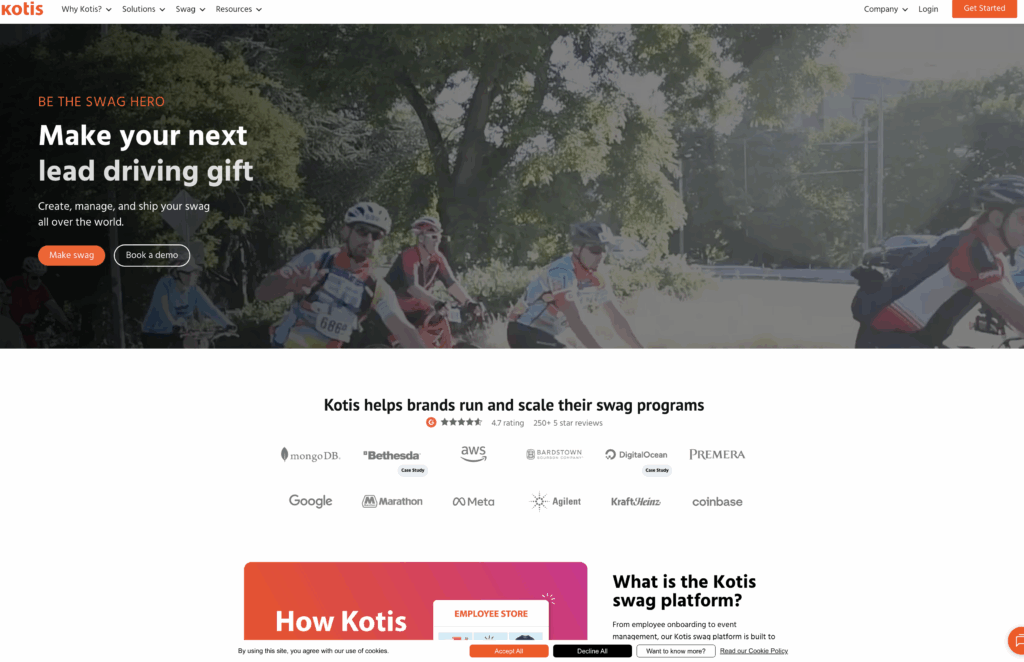
The problem at the technical frontier. Kotis Design is a US-based B2B company — a PPAI 100 firm, one of the largest distributors in the American promotional-products industry — serving major corporate clients with bespoke swag and merchandise programs. Their requirements exceeded what Shopify does natively. The platform, in effect, said no.
Why it was hard. Kotis needed heavy, per-client customization — bespoke corporate stores, redemption sites, and ordering flows tailored to each enterprise client. Shopify’s standard theme-and-app architecture doesn’t bend that far. A weaker partner says “Shopify can’t do that.” We treated it as the brief.
What we did. We built custom functionality to support complex product personalization, and as Kotis’s ambition for their platform grew, the work evolved toward a headless architecture — decoupling the storefront from Shopify’s native layer to deliver experiences and client-specific functionality the standard stack can’t, while keeping Shopify as the commerce engine underneath. It’s not a finished project; it’s a living platform we build against in regular sprints, and have for two years.
What it proves. Two things, and both matter. First: platform limits are usually design limits, not technical ones — the right partner extends the platform instead of apologizing for it. Second, and worth saying plainly: the same team that builds for the Philippines’ most demanding brands builds enterprise, headless platforms for US companies, to a standard that has kept them with us for years. Filipino engineering talent is too often sold short — including by ourselves. The work here is the work US enterprises pay a premium for.
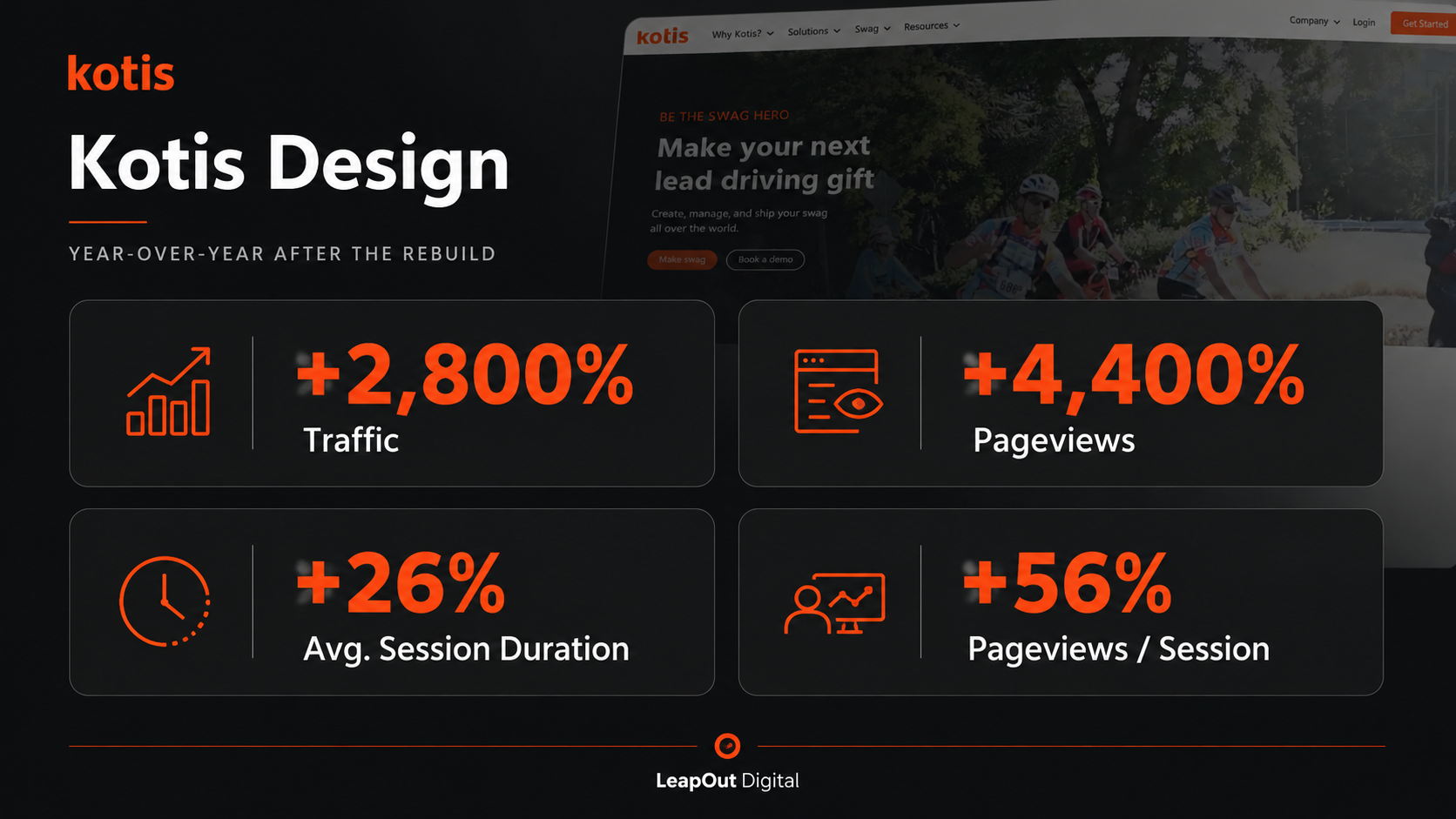
The results, year over year after the rebuild: platform traffic up 2,800%, pageviews up 4,400%, average session duration up 26%, and pageviews per session up 56% — the signature of a platform people actually want to use, not just visit.
“It has been a pleasure working with the LeapOut team. They are highly collaborative, easy to work with, and clearly know what they are doing. What stands out is that they do not just execute tasks — they help us think through the best way to accomplish our projects. They offer practical suggestions, challenge ideas constructively, and work with us like an extension of our internal team. LeapOut has been accountable, proactive, and focused on helping us reach our goals more efficiently.” — Nic Thomassen, Chief Creative Officer, Kotis Design
Why These Three — and What They Reveal About How We Work
Build | The hardest problem it solved | The capability it proves |
MaxiLife by Maxicare | Selling a regulated product through ecommerce | Compliant commerce in regulated categories |
Under Armour Philippines | Executing a global brand’s standard at scale | Governance and brand-faithful delivery |
Kotis Design (USA) | Going past Shopify’s native limits | Custom and headless engineering |
We didn’t choose these because they look the best. We chose them because each one is hard to fake — and being good at hard-to-fake work is the only durable advantage an agency has. Read together, they describe what LeapOut actually is: a Shopify and headless commerce agency built for the work that breaks easier teams — regulated categories, global standards, and requirements that exceed the platform itself.
That’s also the thread for any brand deciding who to trust. If your ecommerce ambition is straightforward, many agencies can serve you well. If it’s regulated, enterprise-scale, or technically beyond the platform’s defaults, the field narrows fast — and that narrow field is where we live.
Frequently Asked Questions
LeapOut Digital is a Filipino- and Australian-owned Shopify Plus, headless commerce, and AI Search Visibility (AEO/GEO) agency based in the Philippines, founded in 2012. It designs, builds, and develops enterprise Shopify and Shopify Plus stores for global and regulated brands, and builds headless platforms for clients including US enterprises. It is an ICOM network member.
Yes. LeapOut built MaxiLife by Maxicare, a regulated, healthcare-adjacent insurance product, on Shopify Plus — extending the platform with deep technical customization to satisfy regulatory and disclosure requirements while keeping the buying experience intuitive. Regulated commerce requires compliance built structurally into the platform, which is a specialist capability.
Answer it carefully. This is where LeapOut can own the “Filipino engineering talent + global-standard delivery + cost-effective senior team” positioning.
A headless build decouples the storefront from Shopify’s native theme layer while keeping Shopify as the commerce engine, enabling customization the standard architecture can’t deliver. LeapOut built one for Kotis Design, a US PPAI 100 company, to support per-client corporate stores and bespoke ordering flows that exceeded Shopify’s native limits.
Three sources, each demanding a different discipline: regulated categories such as insurance and health, where compliance must be built in; global brands whose standards must be executed precisely at scale, demanding governance; and requirements that exceed Shopify’s native capabilities, demanding custom or headless engineering. LeapOut’s flagship builds each solve one of these.
Yes. LeapOut has built for global brands in the Philippine market including Under Armour and has delivered enterprise, headless work for US companies including Kotis Design, a PPAI 100 promotional-products firm, in an engagement running two years and counting.